
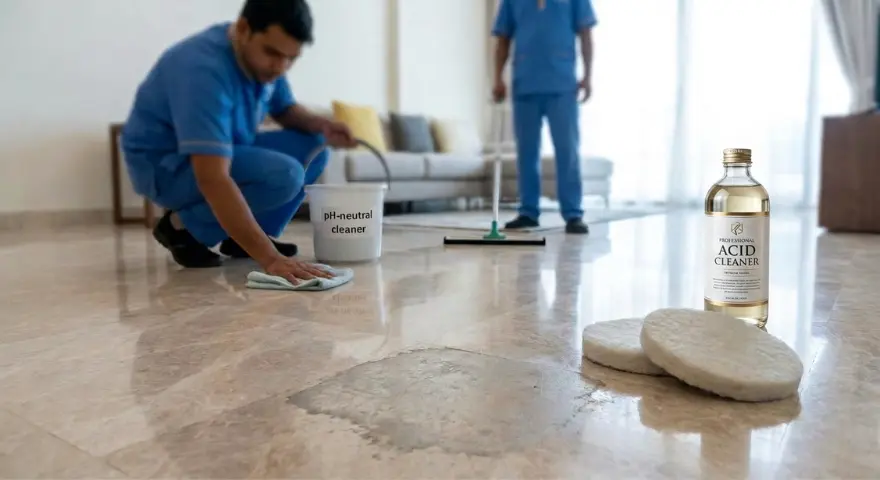
Dubai homeowners invest significantly in luxury marble floors — Calacatta Gold, Carrara White, and Statuario are the hallmarks of premium villas across Palm Jumeirah and Emirates Hills. Yet one of the most common and preventable sources of long-term marble damage is something used every single day: the water from the tap. Dubai's notoriously hard municipal water supply, combined with a widespread misconception that acidic household cleaners remove limescale, is silently destroying polished marble surfaces across the emirate. This guide covers exactly how to clean marble floors in Dubai safely, effectively, and without compromising the professional polish your stone investment depends on.
Why Dubai's Hard Water Is a Serious Threat to Marble Floors
Marble is composed primarily of calcium carbonate — a mineral that is chemically reactive with both acids and highly mineralised water. Dubai's tap water is desalinated but retains very high levels of dissolved minerals, particularly calcium and magnesium. The Total Dissolved Solids (TDS) in Dubai's municipal supply typically range between 300 and 600 parts per million, placing it firmly in the "very hard" category by international water quality standards.
What Happens When Hard Water Meets Marble
Every time marble floors are mopped with Dubai tap water — even with a cleaning product — a thin film of mineral-rich water is left behind. As this water evaporates in Dubai's air-conditioned interiors, the dissolved minerals are deposited directly onto the marble surface as white, chalky residue. Initially, this appears as a light haze after cleaning. Over weeks and months of repeated mopping with hard tap water, these calcium and magnesium deposits bond progressively deeper into the stone's micro-pores, creating what are commonly known as limescale stains or hard water marks — a cloudy, dull film that household cleaning cannot remove.
The Acid Trap: Why the Common Fix Makes Things Worse
The instinctive response to white limescale is to reach for something acidic — vinegar, lemon juice, or citrus-based bathroom cleaners. This logic works on ceramic tiles, glass, and stainless steel, where acid dissolves calcium deposits effectively. On marble, however, it causes catastrophic and irreversible damage. The acid reacts immediately with the calcium carbonate in the stone itself, etching the surface and creating dull, rough patches with a slightly frosty texture. These etch marks cannot be cleaned away — they require professional diamond re-polishing to restore. This is the single most common mistake made by Dubai residents when attempting marble maintenance.
The following products will permanently etch, dull, or discolour your marble and must never be used: white vinegar, apple cider vinegar, lemon juice, lime juice, bleach, ammonia, bathroom limescale removers, grout cleaners, multi-surface sprays, and any product with a pH below 7 or above 9. Even a single application can cause visible etch damage on polished marble surfaces.
The Correct Products for Cleaning Marble in Dubai
Professional marble cleaning in Dubai relies on a very simple chemical principle: use only pH-neutral products formulated specifically for natural stone. A pH of exactly 7 — neutral — will clean marble effectively without triggering any chemical reaction with the calcium carbonate in the stone. Here is what to look for and what to avoid:
| Product Type | Safe for Marble? | Reason |
|---|---|---|
| pH-neutral stone cleaner | Yes | Formulated specifically for calcium carbonate stones; no chemical reaction |
| Distilled or filtered water (alone) | Yes | No dissolved minerals to leave deposits; safe for light daily cleaning |
| Dubai tap water | No | High TDS (300–600 ppm) leaves mineral deposits with every use |
| White vinegar / lemon juice | No | Acidic (pH 2–3); chemically etches and permanently dulls marble |
| Bleach / ammonia cleaners | No | Discolours veining, strips polish, and weakens stone structure over time |
| Multi-surface bathroom sprays | No | Typically acidic or alkaline; not pH-balanced for natural stone |
| Marble "polish" sprays (supermarket) | No | Deposits wax coating that traps contaminants; complicates future restoration |
Even with the correct pH-neutral stone cleaner, always dilute it in distilled or reverse-osmosis filtered water — never Dubai tap water. The cleaner may be safe, but the solvent (tap water) will still deposit minerals on the marble as it evaporates. A water filter jug is an inexpensive and highly effective solution for day-to-day marble floor maintenance in UAE properties.
The Daily Marble Cleaning Protocol for Dubai Homes
Following a consistent, correct daily routine is the single most effective way to preserve professionally polished marble in Dubai's environment. This protocol takes only a few minutes per area but dramatically extends the interval between professional treatments.
Dry Dust Mop First — Always
Before any wet cleaning, remove all loose dust and grit with an electrostatic microfibre dry mop. Dubai's desert silica particles are highly abrasive — mopping over them wet grinds the particles across the polished surface, causing micro-scratches with every pass. In high-traffic entry areas, dry mopping twice daily is strongly recommended during shamal dust season.
Prepare Your Cleaning Solution Correctly
Add the recommended dose of pH-neutral natural stone cleaner to a bucket of distilled or filtered water. Use cold or lukewarm water only — hot water accelerates mineral deposition from any residual tap contamination and can open the stone's micro-pores unnecessarily. Follow the product's dilution ratio exactly; using more cleaner is not more effective and leaves a residue.
Mop With a Damp — Not Wet — Microfibre Flat Mop
Wring the mop head thoroughly so it is barely damp. Excess moisture is the enemy of polished marble in Dubai — it penetrates micro-pores, carries minerals in, and creates the wet-dry cycling that causes internal calcium carbonate etching. Work in small sections, mopping with light, even pressure. Avoid circular motions; straight, overlapping passes are more effective and less likely to redistribute abrasive particles.
Dry Buff Immediately After Each Section
This is the step most Dubai homeowners skip — and the one that matters most. Using a clean, dry microfibre cloth or dry flat mop, immediately buff the cleaned section to remove all moisture before it can evaporate and deposit minerals. In Dubai's indoor climate, even minimal moisture left on marble will leave a haze after the AC dries it. Buff until the surface feels completely dry and slightly warm to the touch.
Address Spills Immediately
Any liquid spill — coffee, tea, juice, cooking oil, wine — must be blotted (not wiped) immediately with a clean cloth. Wiping spreads the spill and drives it into pores. Blotting lifts it out. After blotting, clean the area with your pH-neutral solution and dry buff as above. Never allow acidic liquids — citrus juices, wine, carbonated drinks, coffee — to sit on marble for any period of time.
How to Safely Remove Existing Hard Water Marks from Dubai Marble
If hard water marks have already developed on your marble floors — the white, cloudy, or hazy patches that don't disappear after regular cleaning — the approach depends entirely on how deeply the mineral deposits have bonded into the stone.
Stage 1: Fresh Deposits (Less Than 2 Weeks Old)
Recently formed hard water deposits can often be lifted using a slightly more concentrated application of pH-neutral stone cleaner, left on the surface for 3–5 minutes before buffing with a damp microfibre cloth. This gentle dwell time allows the cleaner's surfactants to break the mineral film's surface bond without any chemical reaction with the stone itself. Never use a scrubbing pad — only microfibre cloths or mop heads.
Stage 2: Established Deposits (Weeks to Months Old)
For deposits that have bonded more firmly into the stone's surface, a professional-grade neutral stone descaler — specifically formulated to dissolve calcium without acidifying below pH 6.5 — may be applied by a trained technician. These products walk a precise chemical line and must not be confused with household descalers, which are typically far too acidic for marble contact. This is not a DIY product and must only be applied by a professional stone care specialist.
Stage 3: Deep-Bonded or Etched Deposits
When hard water deposits have been left untreated for months or when vinegar or acidic cleaners have been applied previously, the marble surface may have both mineral build-up and chemical etching occurring simultaneously. In this case, cleaning alone cannot restore the finish. Professional diamond polishing is required to mechanically remove the damaged surface layer and restore the crystalline reflectivity of the stone.
Install a whole-house water softener or point-of-use reverse osmosis filter for your cleaning water supply. This is one of the highest-ROI investments a Dubai homeowner can make for marble floor longevity. Reducing the TDS in your cleaning water to below 50 ppm eliminates the primary cause of recurring hard water deposits and can extend the life of a professional polish by 40–60% compared to using unfiltered Dubai tap water.
Complete Do's and Don'ts for Marble Cleaning in Dubai
Below is a comprehensive reference checklist for anyone responsible for the daily maintenance of marble floors in a Dubai residential or commercial property. Share this with household staff, property managers, or cleaning teams to prevent the most common and costly marble maintenance mistakes in the UAE.
- Do use pH-neutral stone cleaner: Only products explicitly labelled "safe for natural stone" and pH 7 should contact your marble floor under any circumstances.
- Do use distilled or filtered water: Eliminate mineral deposits at the source by never using Dubai tap water for marble floor cleaning or rinsing.
- Do dry buff immediately: After every damp clean, follow with a dry microfibre buff to remove all moisture before it evaporates and deposits minerals.
- Do dry mop before wet cleaning: Remove abrasive silica dust before applying any moisture to prevent micro-scratching the polished surface.
- Do use felt pads on furniture: All chair legs, table bases, and furniture feet should have high-quality felt pads to prevent scratching the marble surface during normal use.
- Do place entrance mats at all doors: Use large-format mats (minimum 1.5 metres deep) at every entry point to capture Dubai's abrasive silica dust before it reaches the marble.
- Do blot spills immediately: Lift spills with a clean cloth using a blotting motion — never wipe across the marble as this spreads the spill and drives it into the stone.
- Don't use vinegar, lemon juice, or citrus products: These are among the most destructive substances you can apply to marble and will cause irreversible etching on contact.
- Don't use bleach or ammonia: These alkaline chemicals strip polish, cause discolouration in veining, and permanently alter the stone's surface chemistry over time.
- Don't use steam mops: High-pressure steam forces moisture and mineral deposits deep into marble's micro-pores, accelerating internal etching and weakening the crystalline surface layer.
- Don't use abrasive scrubbing pads: Scouring pads, green scrubbers, and steel wool create micro-scratches across the polished surface that dull reflectivity permanently.
- Don't allow water to pool or air-dry on marble: Any standing water on marble in Dubai's climate will leave a mineral ring as it evaporates — always dry immediately.
The Role of Sealing in Protecting Dubai Marble from Hard Water
Even with perfect daily cleaning habits, Dubai's hard water and mineral-laden environment will gradually work its way into unprotected marble. Professional marble sealing in Dubai fills the stone's micro-pores with a penetrating impregnating sealer that dramatically reduces the rate at which water, minerals, and contaminants can enter the stone.
In Dubai's conditions, a high-quality penetrating nano-sealer should be professionally applied every 12–18 months for residential marble and every 6–9 months for high-traffic commercial applications. This is not a topical coating that sits on the surface — it penetrates into the stone and creates a subsurface barrier that repels water at the micro-pore level without altering the stone's appearance, texture, or reflectivity.
A properly sealed marble floor is significantly more forgiving of accidental hard water exposure, spills, and the inevitable minor cleaning variations that occur in any household. Sealing does not eliminate the need for correct daily cleaning protocols, but it does provide a vital additional layer of protection against Dubai's uniquely challenging water chemistry.
Cleaning Considerations for Different Marble Types in Dubai Properties
Different marble varieties found in Dubai properties have slightly different sensitivities that are worth understanding before establishing your cleaning programme.
Calacatta Gold and Carrara White (Italian marbles) are the most unforgiving when it comes to hard water staining. Their bright white backgrounds make even light mineral haze immediately visible, and any yellowing from alkaline cleaners shows dramatically against the white background. These stones demand the strictest adherence to distilled water and pH-neutral cleaning without exception.
Statuario and Arabescato share the same sensitivity as Calacatta but their bold grey veining can sometimes mask early-stage mineral deposits, leading homeowners to overlook the issue until it has progressed to a stage requiring professional intervention. Regular inspection under raking light is important.
Crema Marfil and Turkish Afyon are widely used in Dubai bathroom floors and shower surrounds — environments with the highest hard water exposure in any property. Their warmer beige tones hide some mineral haze, but their porous structure makes them particularly vulnerable to deep mineral penetration if sealing is not maintained. Shower marble requires professional cleaning and re-sealing every 6 months in Dubai.
Emperador Dark and Nero Marquina (Spanish marbles) present a unique challenge: hard water deposits appear as bright white marks against the dark background, making them immediately obvious. Additionally, standard crystallization treatments can leave white calcium hazing on dark stones — specialist dark-stone formulations must be used exclusively on these varieties.