
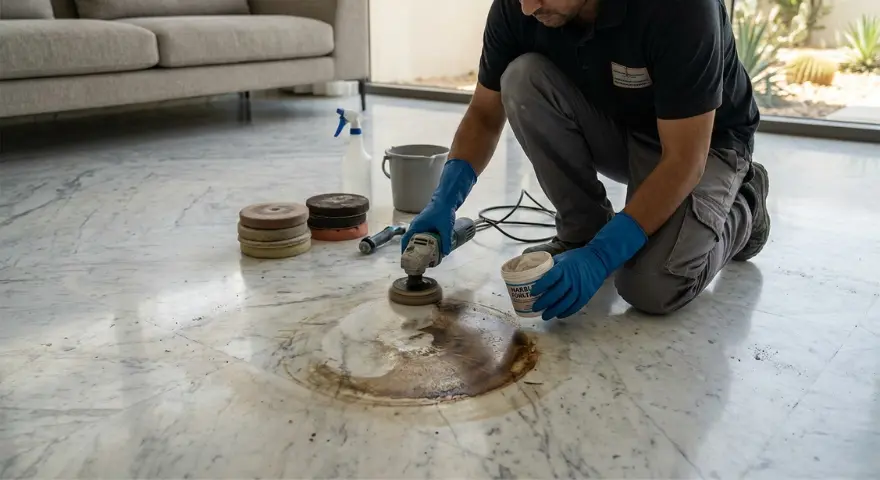
Marble is among the most coveted flooring materials in Dubai's luxury villas, penthouses, and commercial lobbies — yet its natural porosity makes it uniquely vulnerable to staining in the UAE's demanding environment. Coffee spills, cooking oils, saffron, hard water mineral deposits, and rust marks from metal furniture are among the most common culprits encountered by our restoration team across Dubai properties. Left untreated or tackled with the wrong products, these stains penetrate deep into the stone's pore structure and become progressively more difficult — and sometimes impossible — to remove without professional intervention . This complete guide explains how Dubai's most experienced marble care specialists identify, classify, and permanently remove every category of stubborn stain from natural stone surfaces.
Why Marble Stains So Readily in Dubai Properties
Understanding why marble is particularly prone to staining in Dubai helps explain why professional treatment is so often necessary and why DIY approaches so frequently make the problem worse. Marble is a metamorphic rock composed primarily of calcium carbonate — a mineral matrix that is naturally porous, chemically reactive with acids, and readily absorbent of liquids and pigments.
In Dubai's environment, this vulnerability is compounded by several factors that homeowners in cooler, drier climates simply do not face. The combination of high ambient humidity, extremely hard municipal water, abrasive silica dust from sandstorms, and the intense heat that opens the stone's pores more readily creates conditions where staining agents penetrate marble faster and deeper than they would anywhere else. Many of the cooking ingredients common in Dubai households — saffron, turmeric, pomegranate, and Arabic coffee — contain highly concentrated pigments that bond rapidly to the calcium carbonate matrix of unsealed stone.
The Difference Between Stains and Etching
Before any stain removal work begins, it is essential to distinguish between two distinct types of surface damage that are frequently confused by Dubai homeowners: staining and etching. Staining is the absorption of a pigmented substance into the pores of the marble, causing a visible discolouration that may be dark, coloured, or cloudy. Etching, by contrast, is chemical damage to the surface of the stone caused by acidic substances dissolving the calcium carbonate — producing dull, lighter patches that have a matt or roughened texture compared to the surrounding polished surface.
Both conditions are common in Dubai marble and frequently occur together — for example, when coffee or lemon juice spills cause both pigment absorption and acid etching simultaneously. However, they require completely different treatments: stains are addressed through chemical extraction or poultice drawing techniques, while etching requires mechanical re-polishing through diamond honing and professional marble polishing in Dubai. Applying a cleaning agent to an etched surface will not restore the gloss — this is one of the most common mistakes made by Dubai homeowners attempting DIY marble repair.
In over 80% of the marble stain removal assessments our team conducts across Dubai villas and apartments, we find that the homeowner has already attempted cleaning with an acidic product — most commonly vinegar solution, bathroom descaler, or a general multi-purpose spray. While the original stain may have partially lightened, the acid has simultaneously etched the surface around it, creating a dull, roughened patch that is now both stained and structurally damaged. This double damage is significantly harder and more expensive to repair than the original stain alone. Always call a professional before attempting chemical treatment on stained marble.
Identifying the Six Most Common Marble Stain Types in Dubai
Professional marble stain removal in Dubai always begins with accurate identification of the stain type, because each category of contaminant requires a different chemical approach and extraction method. Applying the wrong treatment will at best have no effect and at worst permanently set the stain or cause additional surface damage.
Oil-Based Stains
Cooking oils, butter, ghee, hand creams, and body oils are among the most frequently encountered stains in Dubai kitchen and bathroom marble. Oil stains typically appear as dark, slightly translucent patches that deepen in colour when wet. They penetrate marble's calcium carbonate pores readily, especially in warm conditions, and spread outward over time if left untreated. Oil-based stains require alkaline chemical treatment combined with an absorbent poultice compound to draw the oil out of the pores and emulsify it for removal.
Organic Stains
Arabic coffee, saffron, turmeric, pomegranate juice, red wine, tea, and food colouring fall into the organic stain category — and these are by far the most aggressive and prevalent staining agents encountered on Dubai marble. The concentrated pigments in these substances bond quickly to marble's mineral surface and can penetrate several millimetres deep within hours of a spill on unsealed stone. Organic stains are treated with hydrogen-peroxide-based solutions applied under controlled concentrations and dwell times, sometimes in combination with a poultice application for deep-set cases.
Hard Water and Mineral Stains
Dubai's municipal water supply carries some of the highest dissolved mineral concentrations of any major city globally. Calcium, magnesium, and silica deposits build up on marble surfaces around taps, showers, and wet areas, initially forming white surface crusts that can be removed with careful mechanical methods. When water repeatedly penetrates unsealed marble, however, these minerals crystallise within the stone's pore structure and cause internal staining that appears as white clouding, grey tones, or persistent milky patches that do not respond to surface cleaning. Advanced mineral stain extraction or diamond honing is required to address internalised hard water damage.
Rust Stains
Metal furniture legs, decorative objects, steel wool cleaning pads, and corroding reinforcement beneath stone tiles all contribute to rust staining on Dubai marble floors and wall surfaces. Rust stains appear as orange, brown, or red-brown discolouration that can be localised around a contact point or spread outward in a halo pattern. They require specialised iron-reducing chemical treatment — specifically formulated rust removers designed for use on natural stone — which dissolve the iron oxide compounds without damaging the marble. Standard acidic rust removers sold for general household use will etch marble and must never be used on stone surfaces.
Biological Stains
Mould, mildew, algae, and bacterial growth cause biological staining on marble surfaces in Dubai bathrooms, outdoor terraces, and pool surrounds — environments where moisture combines with warm temperatures to create ideal conditions for microbial growth. Biological stains present as black, green, or grey patches and may be accompanied by a musty odour. Treatment requires specialist biocidal stone cleaners that eliminate biological growth without harming the marble, followed by thorough rinsing, drying, and professional sealing to prevent re-colonisation of the stone's pore network.
Paint, Adhesive, and Construction Stains
Dubai villa renovation projects frequently leave marble floors contaminated with paint splashes, tile adhesive, grout haze, cement residue, and construction sealant. These stains require mechanical removal techniques — careful scraping and controlled use of specialised solvents selected to dissolve the specific contaminant without etching or abrading the stone surface. Cement and grout haze in particular are alkaline and will bond chemically with the calcium carbonate of the marble if not removed promptly after installation. For hardened construction contamination, diamond honing may be required to restore the surface beneath the deposit.
The Professional Marble Stain Removal Process in Dubai
Professional marble stain removal in Dubai follows a rigorous, multi-stage methodology that begins with diagnosis and ends with protective sealing — ensuring that the stone is not only restored but safeguarded against future staining. Here is how our specialist team approaches every stain removal project across Dubai properties.
Stage 1: On-Site Assessment and Stain Diagnosis
Every professional stain removal engagement begins with a thorough on-site assessment of the affected marble. Our technicians examine the stain's colour, texture, location, spread pattern, and response to light — all of which provide diagnostic information about the stain type and depth. We also assess the marble variety, finish, and current condition, noting any existing etching, scratching, or previous treatment attempts that will influence our approach. A small test application of diagnostic reagents may be applied in an inconspicuous area to confirm the stain chemistry before full treatment is undertaken.
Stage 2: Surface Pre-Cleaning
Before targeted stain treatment begins, the entire surface is thoroughly pre-cleaned with pH-neutral stone cleaners to remove all surface-level contamination — dust, cleaning product residues, loose mineral deposits, and any topical soiling that might interfere with the stain treatment chemistry. This pre-cleaning step ensures that the targeted treatments applied in subsequent stages are working on the actual stain compound rather than a layer of surface contamination above it.
Stage 3: Targeted Stain Extraction
This is the core of the professional stain removal process. Based on the diagnosis from Stage 1, our technicians apply the specific treatment chemistry matched to the stain type. For deep-set organic and oil-based stains, this typically involves the application of a professional poultice — a paste-like compound that combines an absorbent material with the appropriate chemical agent, applied to the stained area, covered to slow drying, and left to dwell for 24 to 48 hours. As the poultice dries, it draws the staining compound out of the stone's pores by capillary action and binds it within the absorbent matrix, which is then removed along with the extracted contamination.
For surface-level mineral deposits, controlled mechanical cleaning techniques are used. For rust stains, iron-specific reducing agents are applied with carefully managed contact times. For biological staining, biocidal treatments are applied and allowed to penetrate fully before removal. Multiple treatment applications may be required for severe or long-standing stains.
Never attempt to remove marble stains with vinegar, lemon juice, bleach, baking soda, or any standard household cleaning product. All of these will chemically react with marble's calcium carbonate surface, causing etching that permanently dulls the finish and worsens the appearance of the stone. Even products marketed as "marble cleaners" in Dubai supermarkets and hardware stores may contain acidic or abrasive agents that are harmful to polished stone. For any stain that does not immediately wipe away with warm water and a soft cloth, contact a professional marble care specialist before attempting further treatment.
Stage 4: Surface Restoration After Stain Removal
Once the staining compound has been successfully extracted, the affected area is assessed for any residual surface condition issues. If the stain was accompanied by etching — or if multiple poultice applications have slightly altered the surface texture — professional diamond honing and marble polishing in Dubai is carried out to restore the gloss and texture to match the surrounding stone precisely. This step is critical for achieving a seamless, invisible repair rather than a clean patch in an otherwise dull area.
Stage 5: Protective Sealing
The final and arguably most important step after professional stain removal is the immediate application of professional nano-sealing to the treated and restored surface. A marble surface that has just undergone stain removal has freshly opened pores from the extraction process — making it more vulnerable to re-staining than it was before treatment. Applying professional nano-sealing in Dubai immediately after restoration locks in the clean surface and creates an invisible barrier that prevents future staining from penetrating the stone. Without this step, the same staining can recur within weeks.
Dubai Marble Stain Quick Reference Guide
The table below summarises the most common marble stains encountered in Dubai properties, their identifying characteristics, and the treatment approach used by our professional team.
| Stain Type | Visual Appearance | Common Dubai Sources | Professional Treatment |
|---|---|---|---|
| Oil-based | Dark, slightly translucent patch; deepens when wet | Cooking oils, ghee, hand cream, body lotion | Alkaline poultice extraction |
| Organic pigment | Coloured stain (brown, yellow, red, purple) | Arabic coffee, saffron, turmeric, pomegranate, red wine | Oxidising poultice with H₂O₂ |
| Hard water / mineral | White clouding, grey tones, milky patches | Dubai tap water, shower spray, condensation | Diamond honing or mineral extraction |
| Rust | Orange, brown, or reddish halo patterns | Metal furniture legs, steel wool, corroding rebar | Stone-safe iron-reducing chemical treatment |
| Biological | Black, green, or grey patches; possible odour | Mould and mildew in bathrooms, terraces, pool areas | Biocidal stone treatment + sealing |
| Construction | Grey-white haze, splashes, bonded residue | Cement, grout, paint, tile adhesive from renovations | Mechanical removal + solvent + diamond honing |
Preventing Marble Stains in Your Dubai Property
The most effective marble stain removal strategy is prevention — and in Dubai's demanding environment, this means combining professional protective treatments with correct daily maintenance practices. These are the measures our team recommends to every Dubai homeowner after completing a stain removal and restoration project.
- Apply professional nano-sealing immediately: Unsealed marble in a Dubai property will stain again within weeks of being professionally cleaned. Professional nano-sealing creates an invisible molecular barrier that prevents liquids from penetrating the stone, giving you time to wipe spills before they can absorb into the pores. For most Dubai residential floors, this protection lasts three to five years under professional-grade products.
- Blot spills immediately — never wipe: When a spill occurs on marble, blot it immediately with a clean, soft cloth using gentle lifting pressure. Wiping a spill spreads the liquid across a larger area of the stone surface and drives it further into any available pores. Even on sealed marble, prompt blotting is the correct first response to any spill.
- Use only pH-neutral stone cleaners: All routine cleaning of marble in Dubai properties should use pH-neutral cleaners specifically formulated for natural stone. These products clean effectively without reacting chemically with the calcium carbonate surface or degrading the protective sealing. Our team can advise on specific products available in Dubai that meet these criteria.
- Place protective mats in high-risk areas: Use stone-safe mats or coasters beneath metal furniture legs, plant pots, decorative objects, and appliances in kitchens — all common sources of rust and oil staining on Dubai marble floors. Ensure that mat backings are rubber-free, as some rubber compounds can discolour marble over time.
- Rinse bathroom marble after use: In Dubai bathrooms, the combination of hard water, soap residue, and humidity creates aggressive staining conditions on unprotected marble. A brief rinse with clean water after showering and a wipe down of marble surfaces prevents mineral deposits from drying onto the stone and beginning the process of absorption.
- Schedule annual professional maintenance: Include professional marble maintenance as part of your annual Dubai property care schedule. A yearly inspection by a trained stone care technician identifies any developing staining, sealing degradation, or surface condition issues before they progress to the point of requiring major intervention. Combined with professional crystallization in Dubai, annual maintenance keeps marble in showroom condition indefinitely.
When to Call a Professional Marble Stain Removal Specialist in Dubai
While prompt blotting of fresh spills and correct daily cleaning can manage surface-level soiling on well-sealed marble, there are clear situations where attempting further DIY treatment is likely to cause more damage than the original stain — and where professional intervention is the only reliable path to full restoration.
Stains That Have Penetrated the Stone Surface
If a stain remains visible after gentle cleaning with warm water and a soft cloth, it has penetrated the stone's pore structure and can only be extracted by professional poultice treatment. Continuing to scrub or apply cleaning agents will not draw the stain out — it will only damage the surface above it.
Stains Accompanied by Dullness or Roughness
If the stained area also has a dull, mat, or slightly roughened texture compared to the surrounding marble, etching has occurred alongside the staining. This requires professional diamond honing and polishing to restore — chemical treatment alone will not address the surface damage. This is particularly common in Dubai kitchen marble where acidic food and drink spills cause simultaneous pigment absorption and surface etching.
Orange or Brown Staining Around Metal Objects
Rust staining from metal furniture, decorative items, or structural sources spreads laterally through the marble's pore network over time and becomes significantly more difficult to extract the longer it remains. Rust-specific professional treatment should be sought as soon as rust staining is identified — and the metal source causing the staining must be removed or isolated to prevent recurrence.
Recurring Stains After Cleaning
Stains that reappear in the same location shortly after cleaning are drawing up from deeper within the stone's pore structure — a classic sign that the contaminant source is still present below the surface and the stone is unsealed. Professional deep extraction followed by nano-sealing is the only effective resolution.
The most cost-effective time to address marble staining in a Dubai property is as soon as it is identified — not after months or years of attempted DIY treatment have compounded the original damage. A fresh stain that has been in the stone for days or weeks is dramatically easier and less expensive to remove than one that has been present for months and has been repeatedly treated with incorrect products. If you are unsure what type of stain you are dealing with or which treatment approach is appropriate, our team offers free on-site assessments across all Dubai communities and can provide a transparent quote before any work begins.
Marble Stain Removal vs Full Marble Restoration: What Does Your Dubai Floor Need?
Many Dubai homeowners discover, during a professional stain removal assessment, that their marble has accumulated damage beyond simple staining — including deep scratching, widespread etching, surface dulling from incorrect cleaning, and micro-cracking. In these cases, targeted stain removal alone will resolve the visible discolouration but leave the floor looking inconsistent — with clean, treated patches against a surrounding surface that remains dull or damaged.
Our team always provides an honest assessment of whether targeted stain removal or a more comprehensive marble restoration in Dubai would deliver the best outcome for the specific floor and budget. In many cases — particularly for floors with multiple stains across a wider area, or where etching is widespread — full restoration through diamond grinding, honing, and re-polishing delivers far better value than targeted spot treatments, because it addresses every surface condition issue simultaneously and delivers a completely uniform result across the entire floor.
The decision between spot stain removal and full restoration depends on the extent of damage, the marble variety, the desired finish level, and the overall condition of the surrounding surface. Our specialists are always willing to walk Dubai homeowners through both options, including the expected outcomes and long-term maintenance implications of each approach.