
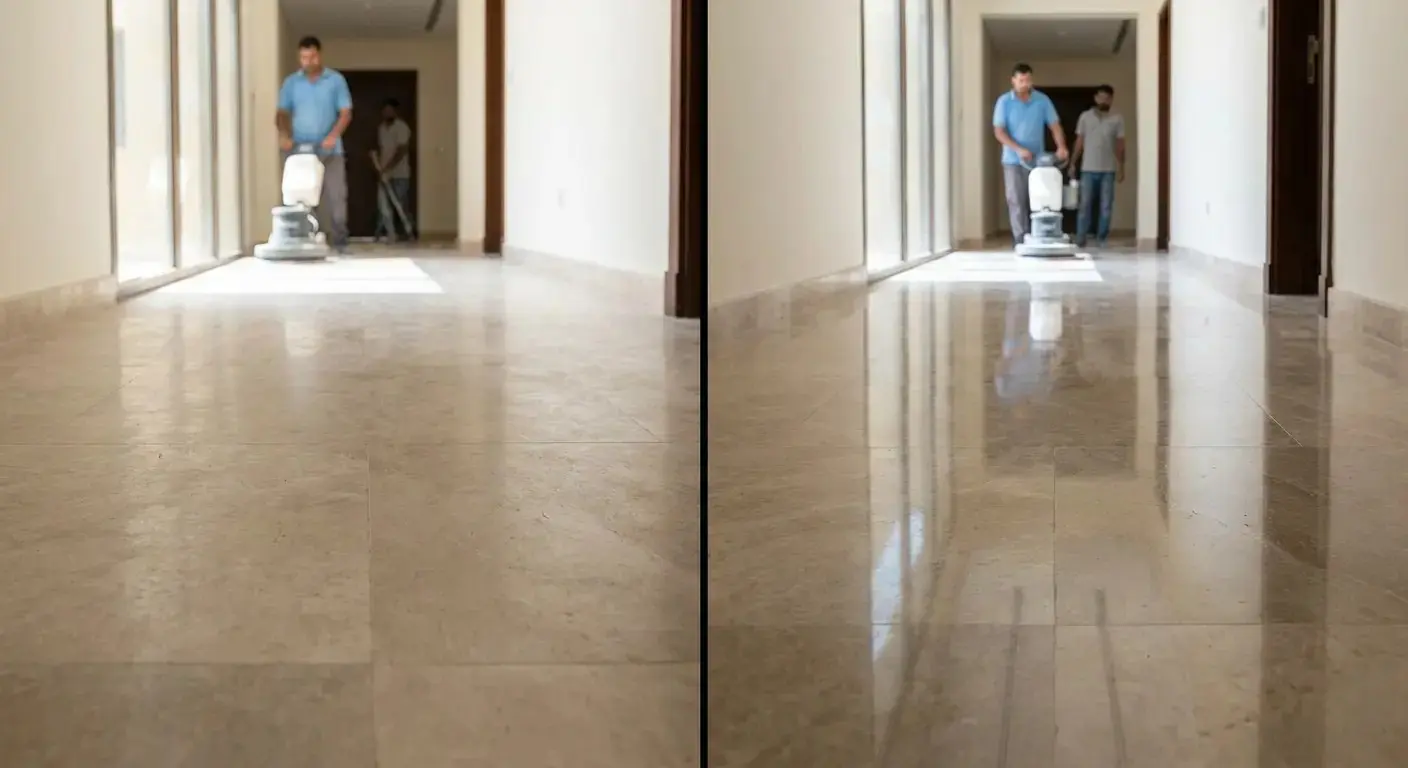
One of the most consequential decisions a Dubai villa owner makes about their marble floors is not which stone to select — it is which finish to apply. Honing and polishing produce dramatically different visual effects, tactile qualities, and performance characteristics, and in Dubai's uniquely demanding indoor environment of high humidity, abrasive sand dust, and intense lifestyle demands, choosing the wrong finish for the wrong room can mean years of unnecessary maintenance challenges, accelerated wear, and a surface that never quite lives up to the stone's full potential. This comprehensive guide breaks down the differences between honed and polished marble finishes, examines how each performs in UAE conditions, and helps you make the right decision for every room in your Dubai villa.
What Is Marble Honing and What Does It Produce?
Marble honing is the process of using progressively finer diamond abrasive pads to grind the stone surface to a smooth, flat, uniformly matte finish. The process removes surface scratches, lippage, and irregularities while stopping short of the final polishing stages that would create a gloss. The result is a surface that feels perfectly smooth to the touch but reflects light in a soft, diffused way rather than producing a mirror-like image.
Honed marble retains a natural, understated beauty that complements contemporary and transitional interior design styles — particularly the warm, organic aesthetics that have become prominent in Dubai's luxury residential market over the past several years. The finish softens the visual intensity of highly veined marbles such as Nero Marquina and Calacatta Gold, allowing the stone's natural character to read as texture rather than spectacle.
The Honing Process: What Happens to the Stone
During professional marble honing in Dubai, the technician uses a planetary grinding machine fitted with diamond abrasive segments or pads at grits typically ranging from 50 through to 400 or 800, depending on the desired level of refinement and sheen. Each pass removes microscopic layers of the stone surface, progressively eliminating deeper scratches left by the previous grit level. Professional marble honing services in Dubai stop at the grit level that produces the client's preferred level of matte refinement — from a coarse, textural finish at lower grits to a refined, near-satin appearance at higher grits.
What Is Marble Polishing and What Does It Produce?
Marble polishing takes the process further, continuing through progressively finer diamond grits — typically from 800 through to 1,500, 3,000, and beyond — until the stone surface achieves a high-gloss, mirror-like reflectivity. At this level of refinement, the stone's crystalline structure is sufficiently smooth to reflect images sharply, creating the iconic luxury aesthetic associated with grand hotel lobbies, penthouse interiors, and prestige residential properties throughout Dubai.
Professional marble polishing in Dubai can also be enhanced through crystallization — a chemical process that bonds with the calcium carbonate in the marble surface to create an exceptionally hard, highly reflective layer that significantly extends the life of the polished finish. This combined approach is the industry standard for luxury Dubai properties where the highest possible gloss and durability are required.
Many Dubai homeowners assume that a polished finish is inherently "better" than a honed finish because of its association with luxury. In practice, the superior finish is the one correctly matched to the space. A honed finish in a high-traffic family bathroom will outperform polished marble in that same location in terms of slip-resistance, stain concealment, and longevity between professional maintenance visits. Conversely, a polished finish in a formal living room or entrance hall in a Palm Jumeirah villa creates a level of reflected grandeur that honed marble simply cannot replicate. The skill lies in matching finish to function.
Honed vs Polished Marble: Key Differences for Dubai Villa Owners
Understanding the practical differences between these two finishes in the context of Dubai's specific lifestyle and climate conditions is essential to making the right choice. The following comparison covers the factors that matter most to Dubai property owners.
| Factor | Honed Marble | Polished Marble |
|---|---|---|
| Appearance | Soft matte sheen; natural, understated luxury | High-gloss mirror finish; dramatic, light-amplifying |
| Slip resistance | Higher — safer in wet areas; preferred for bathrooms | Lower when wet — additional anti-slip treatment advised for wet zones |
| Scratch visibility | Scratches less visible; matte surface diffuses light | Scratches highly visible; gloss amplifies surface imperfections |
| Stain absorption | More porous — professional sealing is essential | Slightly less porous — professional sealing still required in Dubai |
| Dubai sand dust impact | Lower visual impact; matte surface conceals micro-abrasion | Higher visual impact; gloss dulls faster from abrasive sand particles |
| Maintenance frequency | Less frequent professional attention needed | More frequent re-polishing; annual inspection recommended |
| Best suited for | Bathrooms, kitchens, family rooms, outdoor terraces | Entrance halls, formal living rooms, master bedrooms, lobbies |
| Design styles | Contemporary, minimalist, organic, transitional | Classical, formal, grand, Art Deco, maximalist |
How Dubai's Lifestyle Affects the Honing vs Polishing Decision
Dubai's indoor environment presents a set of conditions that directly influence how each marble finish performs over time. Understanding these factors helps villa owners make a genuinely informed decision rather than one based purely on aesthetics.
Fine Sand Dust and Micro-Abrasion
Dubai's sandstorm season — and the persistent fine airborne silica dust present year-round — is among the most significant threats to polished marble surfaces. When sand particles settle on a polished marble floor and are walked over, they act as fine abrasives that gradually dull the mirror finish from the top down. This dulling effect is particularly pronounced in entrance halls and open-plan living areas where foot traffic is heaviest. On honed marble, the same abrasion occurs but is far less visible because the matte surface does not reflect light sharply enough to reveal the micro-scratches left by sand particles.
High Humidity and Condensation
Dubai's coastal humidity — combined with the cold marble surfaces created by powerful air conditioning systems — produces condensation cycles that introduce moisture into unprotected stone. Both honed and polished marble absorb this moisture without professional sealing, but honed marble's slightly more open pore structure means it is marginally more susceptible to moisture-related staining if left unsealed. In bathroom environments where marble walls and floors are in continuous contact with water, honed marble with professional nano-sealing in Dubai is typically the preferred specification — offering better grip underfoot while sealed protection eliminates the porosity concern.
Cooking Habits and Lifestyle Staining
The cooking traditions prevalent in many Dubai households — involving saffron, turmeric, pomegranate, Arabic coffee, and generous cooking oils — produce some of the most aggressive staining agents that marble will encounter anywhere in the world. In kitchen environments, honed marble has a practical advantage: its matte surface is far more forgiving of the surface etching caused when acidic food or drink contacts the stone briefly, because the matte finish naturally conceals the dull patches that acid etching creates. On polished marble in the same kitchen, even minor acid contact produces immediately visible dull spots that break the mirror continuity and require professional re-polishing to address.
Regardless of whether your marble is honed or polished, never use acidic cleaning products — including vinegar, lemon juice, bathroom descalers, or general-purpose spray cleaners — on any natural marble surface. These products react chemically with marble's calcium carbonate structure, dissolving the surface and creating irreversible etch marks. On polished marble, this damage is immediately obvious. On honed marble, it may initially be less visible but accumulates over time into a surface that no amount of cleaning can restore. Always use only pH-neutral, stone-safe cleaning products on both honed and polished marble in your Dubai home.
Room-by-Room Guide: Honed or Polished Marble for Your Dubai Villa
The optimal finish varies significantly depending on where the marble is installed within a Dubai property. This room-by-room guide reflects the recommendations our specialists give to villa owners across Palm Jumeirah, Emirates Hills, Dubai Hills Estate, and Downtown Dubai.
Entrance Hall and Main Foyer
The entrance hall of a Dubai villa is the first impression the property makes, and polished marble is almost always the correct choice here. The reflective surface amplifies the volume of high-ceilinged foyers, catches the light from chandeliers and floor-to-ceiling glazing, and delivers the unmistakable sense of luxury arrival that defines prestige UAE properties. While entrance halls do receive heavy foot traffic and sand from outside, the prestige benefit of a polished finish in this showcase space outweighs the maintenance consideration — provided a professional annual re-polish and ongoing crystallization schedule is maintained.
Formal Living and Dining Rooms
Formal reception rooms in Dubai villas — particularly those designed for entertaining — are strong candidates for polished marble. The mirror finish creates a sense of space and light that is unrivalled by any other floor finish, and in rooms where foot traffic is moderate and controlled, the maintenance requirements are manageable with annual professional marble polishing in Dubai. Family living rooms with children, pets, and everyday activity are better served by honed marble — the more forgiving surface conceals the scuffs, micro-scratches, and play-related wear that polished marble would reveal immediately.
Master Bedroom
Master bedrooms represent one of the clearest cases for polished marble. Foot traffic is minimal, lifestyle staining risks are low, and the gloss finish adds a sense of refined elegance to the most private space in the villa. Cosmetics, perfumes, and beauty products are the primary staining risks in master bathrooms, and professional sealing effectively neutralises these. For master bedroom floors specifically, polished marble with professional crystallization delivers a finish that requires only light professional maintenance every 3 to 4 years under typical conditions.
Bathrooms and Wet Rooms
Bathrooms — particularly main family bathrooms and children's bathrooms — are among the strongest cases for honed marble in a Dubai villa. The practical reasons are compelling: honed marble provides significantly better grip underfoot when wet, reducing slip risk; the matte surface conceals the hard water mineral deposits that accumulate rapidly on polished marble in Dubai's high-mineral municipal water supply; and the honed finish is far more tolerant of the cleaning frequency that bathroom floors require. For master en-suite bathrooms in prestige villas, polished marble can be used with appropriate anti-slip treatment and rigorous maintenance — but honed is the safer and more practical default for all bathroom applications.
Kitchen Floors and Countertops
Kitchens present the most demanding environment for marble of any room in a Dubai villa. The combination of cooking oils, acidic foods, heavy foot traffic, and regular cleaning makes honed marble the clear recommendation for kitchen floors. Its matte surface conceals minor acid etching, absorbs traffic wear more gracefully, and is easier to clean without specialist products. For kitchen countertops, honed marble with professional nano-sealing is the specification our team recommends — the sealed matte surface resists staining while the texture is more forgiving of the daily contact with food, utensils, and cleaning that polished countertops would struggle to maintain.
Outdoor Terraces and Pool Surrounds
For outdoor marble applications — including covered terraces, pool decks, and courtyard paving in Dubai villas — honed marble is virtually always the correct choice. The matte finish provides essential grip in areas that become wet from pool use, irrigation, or rainfall. UV exposure from Dubai's intense sun gradually degrades any polished finish in outdoor applications, whereas honed marble ages more gracefully outdoors and requires only periodic professional cleaning and re-sealing to maintain its appearance.
The Role of Marble Crystallization in Both Finishes
Marble crystallization is a treatment that is most commonly associated with polished marble — it is the process that creates the exceptional gloss and hardness of a professionally finished marble floor. However, it is important to understand that crystallization can also be applied to honed marble to deliver hardness and durability benefits without creating a high gloss.
For polished marble in Dubai villas, professional marble crystallization in Dubai is the treatment that transforms a standard polish into the ultra-hard, mirror-bright finish that defines luxury stone care. The chemical reaction between the crystallization compound and the marble's calcium carbonate creates a new surface layer that is harder than the original stone, significantly more resistant to Dubai's abrasive sand dust, and capable of maintaining its gloss considerably longer between professional maintenance visits than polishing alone.
When converting an existing polished marble floor to a honed finish — or vice versa — our specialists always include professional nano-sealing as the final step of the process. A freshly honed surface has more open pores than a polished surface and should be sealed immediately to prevent the absorption of any contaminants introduced during the first days and weeks after the work is completed. Similarly, freshly polished marble should be sealed before the property is re-occupied to lock in the finish and maximise the duration of protection. Combining the finish conversion with sealing in a single visit is always more cost-effective than scheduling them separately.
Maintaining Honed vs Polished Marble in a Dubai Home
The ongoing maintenance requirements of honed and polished marble differ in important ways that villa owners and their housekeeping teams should understand before committing to either finish across a large floor area.
Daily Cleaning: Both Finishes
Both honed and polished marble should be swept or dry-mopped daily in Dubai homes to remove fine sand and dust particles before they can abrade the surface underfoot. This single daily habit extends the professional finish life of both surfaces more than any other maintenance measure. A soft microfibre flat mop or electrostatic dust mop is ideal — avoid string mops that can leave mineral-rich water residues on polished surfaces.
Weekly Damp Mopping: Both Finishes
Weekly damp mopping with a well-wrung microfibre mop and a pH-neutral stone cleaner is suitable for both honed and polished marble. The key difference is that polished marble is more sensitive to water residues: cleaning should always be followed by drying the surface with a clean, dry microfibre cloth to prevent mineral deposit formation from Dubai's hard tap water. Honed marble is slightly more tolerant of minor water contact but should still be dried promptly in high-humidity conditions.
Professional Re-polishing: Polished Marble Only
Polished marble floors in Dubai villas typically require professional re-polishing every 2 to 4 years, depending on foot traffic levels, the presence of sand abrasion, and whether annual crystallization maintenance has been maintained. High-traffic zones such as entrance halls may require professional attention annually. Honed marble does not require periodic re-polishing — its maintenance schedule centres on cleaning and re-sealing rather than surface restoration.
Professional Re-sealing: Both Finishes
Both honed and polished marble require periodic professional nano-sealing to maintain their stain protection. Honed marble should be re-sealed every 2 to 3 years in bathrooms and kitchens and every 3 to 4 years in living areas. Polished marble can typically go slightly longer between sealings — 3 to 5 years in living areas — because its less porous surface provides marginally more inherent resistance to liquid absorption. An annual water-drop test is the simplest way to assess whether resealing is due for either finish.
Annual Professional Inspection: Both Finishes
Including an annual marble care inspection in your Dubai villa's property maintenance schedule is the single most effective way to protect the long-term condition of both honed and polished marble. A trained technician can identify early-stage dulling, sealer depletion, minor etching, and surface wear before they develop into issues requiring more extensive and costly intervention. Early detection allows minor corrective work to be carried out efficiently, maximising the life of the original professional finish.
Making the Final Decision: A Practical Framework for Dubai Villa Owners
With a clear understanding of the characteristics of both finishes and how they perform in Dubai's specific conditions, the following framework helps villa owners arrive at the right specification for each space in their property.
- Choose polished marble for formal, showcase spaces where visual impact and luxury impression are the primary goals — entrance halls, formal reception rooms, master bedrooms, and prestige staircases. Ensure a professional crystallization and annual maintenance schedule is planned from the outset.
- Choose honed marble for practical, high-use spaces where safety, stain concealment, and low-maintenance performance are priorities — bathrooms, kitchen floors, family living areas, children's rooms, and all outdoor applications. Ensure immediate professional nano-sealing after installation.
- Consider a mixed finish strategy — polished in public-facing and showcase zones, honed in private and utilitarian zones — to balance the prestige of a mirror finish against the practicality of a matte surface. This approach is used in the majority of luxury Dubai villa projects our team completes.
- Factor in your housekeeping resources. Polished marble demands more attentive daily maintenance to preserve its appearance. If daily dry-mopping and prompt spill response cannot be guaranteed, honed marble will deliver a better long-term result with lower visible degradation between professional visits.
- Request a sample panel from your marble care specialist before committing to a finish conversion on an existing floor. Seeing both finishes applied to a small section of your actual stone, in your actual lighting conditions, is the most reliable way to confirm the aesthetic result before proceeding with the full project.
- Ensure professional sealing is included in any honing or polishing project. Whether the finished surface is honed or polished, nano-sealing immediately after the work is completed is the treatment that protects the investment and extends the duration of the professional result. Never accept a finish job in Dubai that does not include sealing as the final stage.