
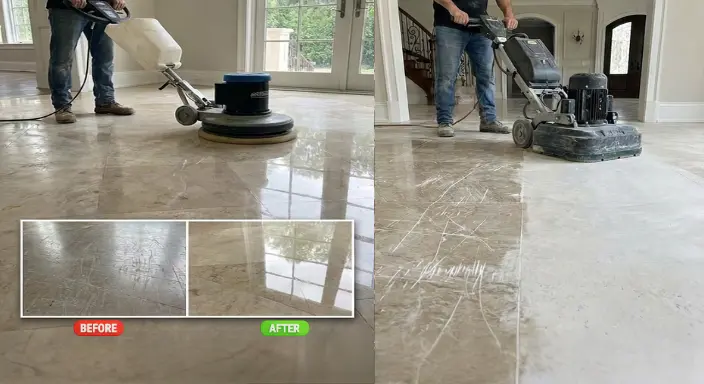
Not every dull marble floor needs the same fix. In Dubai, where luxury properties from Palm Jumeirah villas to Downtown penthouses showcase imported Italian and Turkish marble, homeowners and facility managers often default to "polishing" as the catch-all solution — even when the floor's real problem runs much deeper. Choosing the wrong restoration method wastes money, delays results, and can sometimes worsen the damage. This guide breaks down exactly when polishing is enough, when diamond grinding becomes unavoidable, and how to make the right call for your Dubai property.
Is Your Marble Scratched, Dull, or Structurally Damaged?
The first step in any restoration decision is correctly diagnosing the problem. Marble damage in Dubai properties generally falls into three distinct categories, each requiring a different level of intervention. Misreading which category your floor falls into is the single most common reason restoration jobs disappoint.
Surface Dullness: The Easiest Fix
If your floor has simply lost its reflective shine but remains smooth and flat to the touch, you are likely dealing with surface dullness caused by foot traffic, dust abrasion, or accumulated cleaning residue. This is the most common issue in Dubai homes and is fully correctable through professional polishing alone.
Light Scratching: Still a Polishing Job
Fine, web-like scratches that are only visible under raking light and cannot be felt with a fingernail fall within the range that diamond polishing pads can resolve. These micro-scratches sit entirely within the stone's existing polished layer and do not require material removal.
Deep Scratches, Etching, and Lippage: When Grinding Becomes Necessary
Once damage penetrates below the existing finish — visible gouges, permanent etch marks from acidic spills, cracked tiles, or lippage (where adjoining tile edges sit at different heights) — polishing pads can no longer reach the source of the problem. At this stage, the damaged layer of stone must be physically ground away before any polish will hold.
In our experience across more than 2,500 Dubai restoration projects, roughly one in three villa floors that clients describe as "needing a polish" actually require grinding first. Skipping this step is the leading cause of restoration jobs that look great for a few weeks and then fade right back to dull.
What Is Marble Polishing?
Marble polishing is a surface-level refinement process. A sequence of fine diamond pads, typically starting around 800 grit and progressing up to 3000 grit, is worked across the existing stone surface to remove only microscopic amounts of material. The goal is to refine what is already there — restoring reflectivity without altering the floor's level or thickness. It is fast, relatively low-mess, and ideal for routine maintenance shine in Dubai homes.
What Is Marble Grinding (Honing)?
Grinding, sometimes called honing, is a corrective process. Coarse diamond abrasives — typically starting at 50 to 100 grit — are used on planetary grinding machines to physically remove a layer of damaged stone. This levels uneven tiles, eliminates deep scratches and etching, and creates a uniformly flat surface. Because grinding removes the floor's existing finish entirely, it must always be followed by a full polishing sequence to rebuild the shine.
Never allow a contractor to "polish over" lippage or deep etching to save time. The unevenness or damage will remain hidden beneath a temporary shine and will resurface — often worse — within a few months. Equally, avoid contractors who grind every floor regardless of condition; unnecessary grinding removes stone thickness that can never be replaced.
Signs Your Dubai Property Needs Grinding, Not Just Polishing
Before booking a restoration service, check your marble against these indicators. If two or more apply, grinding should be part of the conversation from the outset.
- Visible lippage: Tile edges sit noticeably higher or lower than their neighbours, creating a trip hazard underfoot.
- Fingernail-deep scratches: You can catch a fingernail in the scratch line rather than just seeing it under light.
- Permanent etch marks: Dull, rough patches near kitchens or bathrooms that remain after buffing or light polishing.
- Cracks or chips: Hairline fractures or chipped edges that affect the structural surface of the stone.
- Never professionally restored: The floor has not been treated since original installation, even after years of heavy foot traffic.
- Uneven sheen: Some areas reflect light clearly while adjoining areas remain flat and hazy, even after cleaning.
The Diamond Grinding Restoration Process for Dubai Properties
When grinding is genuinely required, the process is significantly more involved than a standard polish. Here is how our team approaches a typical grinding restoration on a Dubai villa or commercial floor:
On-Site Assessment & Damage Mapping
We inspect the floor under raking light to map lippage, scratch depth, etching, and crack locations, then confirm whether full-floor grinding or targeted spot-grinding is appropriate before any work begins.
Furniture Removal & Surface Protection
Skirting boards, cabinetry, and nearby furnishings are protected before grinding begins. In occupied Dubai villas and penthouses, this containment step is essential to prevent splash damage from the wet grinding process.
Coarse-to-Medium Diamond Grinding
Planetary grinding machines fitted with 50–200 grit diamond tooling remove the damaged surface layer and level lippage across the floor. Continuous water feed suppresses dust and cools the diamond segments throughout.
Progressive Polishing Sequence
Once the surface is level, we move through a graded sequence of finer diamond pads — 400 through 3000 grit — to rebuild a high-gloss finish on the freshly ground stone. Skipping intermediate grits leaves visible scratch patterns.
Crystallization, Sealing & Final Quality Check
A crystallization compound hardens and brightens the newly polished surface, followed by a penetrating nano-sealer for ongoing protection. The floor is inspected under multiple light angles before handover.
Polishing vs. Grinding: Side-by-Side Comparison
Use this table to quickly cross-reference your floor's condition against the correct restoration method.
| Attribute | Polishing | Grinding (Honing) |
|---|---|---|
| Best for | Surface dullness, light scratching, routine upkeep | Deep scratches, lippage, etching, structural damage |
| Material removed | Minimal — microscopic surface layer only | Significant — removes the damaged stone layer entirely |
| Typical Dubai duration | 1 day for an average villa floor | 2–4 days depending on damage extent |
| Equipment used | Diamond polishing pads, crystallization compounds | Planetary grinding machines with coarse diamond tooling |
| Dust and disruption | Minimal, low-mess process | Higher — requires water suppression and containment |
| Resulting finish | Restores existing gloss | Creates a new, level surface ready for polishing |
| Recommended frequency in Dubai | Every 12–18 months | Every 5–8 years, or after specific damage events |
| Fixes lippage or uneven tiles | No | Yes |
Choosing the Right Method for Your Dubai Property Type
The right restoration approach also depends on how the space is used and what type of property it serves. Here is how the decision typically plays out across common Dubai settings.
Residential Villas with Light to Moderate Wear
Most Palm Jumeirah and Emirates Hills villas with a regular cleaning routine and no major incidents only need scheduled marble polishing every 12–18 months to maintain their shine against Dubai's dust and humidity.
Commercial Lobbies, Hotels & High-Traffic Spaces
High-footfall environments in Business Bay and DIFC accumulate deeper wear far faster. These spaces frequently need an initial grinding pass to correct traffic-path scratching, followed by a more frequent polishing schedule to sustain the finish under constant use.
Newly Installed Marble with Lippage Issues
Even brand-new installations in Dubai developments can suffer from lippage if the substrate wasn't perfectly level during laying. Polishing cannot correct this — only grinding will bring adjoining tiles to a consistent, flush surface.
Older or Previously Neglected Properties
Properties that have never undergone professional marble restoration since installation almost always require a full grinding restoration before regular polishing maintenance can be reintroduced into the upkeep schedule.
How to Choose a Marble Restoration Company in Dubai
Grinding is a far more disruptive and skill-intensive process than polishing, which makes contractor selection even more important. Use this checklist before committing to a restoration company.
- Verify grinding equipment: Confirm the company uses industrial planetary grinding machines, not just single-disc floor polishers, which cannot correct lippage.
- Ask about grit progression: A specialist should clearly explain both the coarse grinding sequence and the follow-up polishing grits used to rebuild the shine.
- Request grinding references: Ask for before/after photos of grinding projects specifically, not just standard polishing jobs.
- Confirm wet grinding method: Dry grinding produces harmful silica dust and inferior results. All professional grinding should use continuous water feed.
- Check insurance coverage: Grinding involves heavier equipment near furnishings and fixtures, so public liability insurance is essential for luxury Dubai properties.