
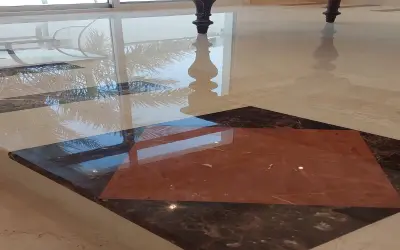
Dubai's marble floors, countertops, and wall cladding represent some of the most significant material investments in any luxury UAE property — yet the vast majority are left without the one treatment that would most effectively preserve them. Marble is a naturally porous stone, and in Dubai's uniquely demanding environment of high humidity, abrasive sand dust, hard water, and intense UV exposure, unprotected marble absorbs stains, moisture, and contaminants at a rate that no amount of cleaning or polishing can fully reverse. This comprehensive guide explains what professional marble nano-sealing is, why it is especially critical for Dubai properties, and how to determine whether your stone investment urgently needs this protection right now.
What Is Marble Nano-Sealing and How Does It Work?
Marble nano-sealing is a professional stone protection treatment that uses advanced nanotechnology to create an invisible, molecular-level barrier within the pores of natural stone. Unlike traditional surface sealers that sit on top of the marble and can peel, cloud, or trap air over time, nano-sealers penetrate deep into the stone's capillary structure — bonding chemically with the mineral matrix itself.
The result is a hydrophobic and oleophobic layer that causes water, oil, and other liquids to bead on the surface and wipe away cleanly, rather than being absorbed into the stone where they can cause permanent staining, internal discolouration, and structural deterioration. Critically, this protection is entirely invisible: the colour, gloss, and texture of the marble remain completely unchanged after a professional nano-sealing application.
Nano-Sealing vs. Traditional Marble Sealers
The term "marble sealer" covers a wide spectrum of products with very different penetration depths, durability profiles, and chemical compositions. Traditional impregnating sealers — the type most commonly sold in hardware stores across Dubai — provide a basic level of surface protection but penetrate only a fraction of the depth that professional nano-sealers achieve. This results in shorter protective lifespans (typically 6 to 18 months for consumer-grade products versus 3 to 5 years for professional nano-sealers) and significantly reduced resistance to the specific staining agents found in Dubai households, including Arabic coffee, saffron, red clay dust, and cooking oils.
In our assessments of Dubai properties where homeowners had self-applied consumer sealers, we regularly find that the protection has failed entirely within 12 months — often without the homeowner's knowledge. The marble continues to look clean on the surface while quietly absorbing contaminants below, building up internal staining that only becomes visible once the floor is professionally cleaned and the underlying discolouration is revealed. Professional nano-sealing applied to correctly prepared stone is the only treatment that delivers reliable multi-year protection in UAE conditions.
Why Dubai's Environment Makes Marble Sealing Non-Negotiable
Dubai presents a combination of environmental conditions that are uniquely damaging to unsealed natural stone. Understanding these factors helps explain why marble sealing — a treatment that might be optional or occasional in cooler, drier climates — is effectively essential for any natural stone surface in a UAE property.
High Ambient Humidity
Dubai's coastal location means that relative humidity regularly exceeds 80% during summer months, and interior air conditioning systems create condensation cycles on cold marble surfaces — particularly in bathrooms, kitchens, and areas adjacent to exterior walls. This persistent moisture exposure drives water into the pores of unsealed marble repeatedly over time, carrying with it dissolved minerals that crystallise within the stone's structure and cause internal staining, white mineral deposits, and progressive surface degradation. Sealed marble repels this moisture entirely, keeping it on the surface where it can be wiped away cleanly.
Hard Water and Mineral Deposits
Dubai's municipal water supply has among the highest mineral content of any major city in the world, with high concentrations of calcium, magnesium, and other dissolved salts. On unsealed marble surfaces — particularly in bathrooms and kitchens — this hard water leaves persistent white mineral deposits that etch into the stone surface when left in contact. These deposits are notoriously difficult to remove from unprotected marble without risking surface damage. Professional nano-sealing in Dubai creates a barrier that prevents mineral-laden water from penetrating the stone, making hard water deposits easy to wipe away before they can bond to the surface.
Abrasive Sand and Dust
Dubai's sandstorm season introduces extremely fine, abrasive silica particles into every building — through open doors, windows, air conditioning intakes, and on the soles of shoes. These particles settle on marble floors and, when walked over, act as fine abrasives that gradually dull the polished surface. On unsealed marble, these same particles also become embedded in the pores of the stone, discolouring the surface from within. Sealed stone resists particle penetration, making it significantly easier to clean between professional maintenance visits.
Cooking Oils and Lifestyle Staining Agents
The cooking traditions of many households in Dubai — involving generous use of saffron, turmeric, pomegranate juice, and Arabic coffee — produce some of the most aggressive staining agents that natural marble will encounter anywhere in the world. Marble's calcium carbonate structure readily absorbs these pigmented oils and organic dyes, and without a sealed barrier, even a brief spill left for minutes can result in a deep stain that requires professional extraction to remove. On properly nano-sealed marble, these same spills bead on the surface and can be wiped away with a soft cloth without any trace.
Never use acidic cleaning products — including vinegar, lemon juice, bathroom descalers, or multi-purpose sprays — on marble surfaces in Dubai. These products chemically react with marble's calcium carbonate composition, dissolving the polished surface layer and creating dull, etched patches that cannot be removed by cleaning alone. This damage is irreversible without professional diamond re-polishing. Even on sealed marble, acidic cleaners should be avoided. Use only pH-neutral stone-safe cleaning products recommended by your marble care specialist.
Five Signs Your Dubai Marble Urgently Needs Sealing
Many Dubai homeowners are unaware that their marble's protective sealing has expired or was never professionally applied. These are the key indicators that your marble surfaces are currently unprotected and vulnerable.
- The water drop test fails: Place a few drops of water on the marble surface and wait 3 minutes. If the water is absorbed and leaves a darker patch, the stone has little or no protective sealing remaining. Properly sealed marble causes water droplets to bead and remain on the surface without absorption.
- Visible dark patches after water exposure: Shower surrounds, bathroom floors, or kitchen areas around the sink that darken after water contact are exhibiting classic signs of moisture absorption into unsealed stone. These patches typically lighten once the water evaporates, but repeated absorption cycles cause cumulative mineral staining.
- Persistent stains that resist cleaning: If regular cleaning fails to remove marks left by coffee, cooking oil, or other household liquids, the stain has penetrated below the surface into the stone's pore structure — a clear indication that the protective sealing is absent or depleted.
- White mineral deposits that return quickly: Hard water deposits around taps, showers, and wet areas that reappear within days of cleaning indicate that mineral-rich water is penetrating the stone surface freely. Sealed marble dramatically slows the rate at which these deposits form and makes them far easier to remove.
- More than three years since last professional sealing: Professional nano-sealers applied to correctly prepared marble typically provide effective protection for 3 to 5 years under normal residential conditions in Dubai. If your marble has not been professionally sealed within this timeframe — or if you are unsure whether it has ever been professionally sealed — a specialist assessment is strongly recommended.
- Newly installed or recently restored marble: Freshly installed marble should be professionally sealed immediately after installation — before the property is occupied and before any cleaning products are used on the surface. Similarly, marble that has been professionally polished or restored should be sealed immediately after restoration to lock in the new surface and prevent immediate re-contamination.
The Professional Marble Nano-Sealing Process in Dubai
Professional marble sealing in Dubai is not simply a matter of applying a product to the stone surface. To achieve multi-year protection that performs reliably in UAE conditions, the process requires thorough preparation, the correct selection of sealing product for the specific marble variety, and precise application technique. Here is how our specialist team approaches every nano-sealing project in Dubai:
Surface Assessment & Absorbency Testing
Before any treatment begins, our technicians conduct a thorough assessment of the marble's current condition, including an absorbency test at multiple points across the floor or surface to map protection levels, and a visual inspection for existing staining, etching, or surface damage that may need to be addressed before sealing. The type, finish, and age of the marble are noted to guide product selection.
Deep Cleaning & Surface Preparation
This is the most critical step in the sealing process. All existing contamination — including mineral deposits, cleaning product residues, grease, wax, and any previous sealer that has broken down — must be completely removed before nano-sealer is applied. Our team uses specialist alkaline and neutral stone cleaners applied under controlled dwell times, followed by thorough rinsing and complete drying. Applying sealer over a contaminated surface traps contaminants permanently within the stone, causing the very discolouration the sealing is meant to prevent.
Product Selection for Marble Type & Environment
Not all nano-sealers perform equally across different marble varieties and installation contexts. Our technicians select specifically formulated products based on the stone's porosity level, its finish (polished, honed, or bush-hammered), whether the surface is indoors or outdoors, and the primary risk factors — moisture in bathrooms, cooking oils in kitchens, or UV exposure in covered outdoor terraces. White and light-coloured marbles such as Calacatta and Carrara require sealers with zero yellowing tendency; darker stones may accommodate different formulations.
Nano-Sealer Application
The nano-sealer is applied evenly across the prepared surface using specialist applicator pads or low-lint cloths in controlled sections, ensuring full and uniform coverage without pooling or missed areas. The application rate and dwell time are carefully managed according to the product specification and the stone's measured absorbency level. Multiple thin coats are applied where necessary to achieve full saturation of the stone's pore network.
Buffing & Residue Removal
Any sealer remaining on the surface after the designated penetration period is carefully buffed away using clean, dry pads. This step prevents surface haze, streaking, or an undesirable sheen from developing as the sealer cures. The finished surface should look and feel identical to the stone before treatment — the protection is entirely internal and invisible.
Curing Period & Final Verification
The sealed surface is allowed to cure fully — typically 24 to 48 hours — before it is subject to water or foot traffic. Our technicians conduct a final water-drop test on the cured surface to verify that correct bead formation is occurring across all treated areas, confirming that the nano-sealer has achieved full penetration and effective protection. We provide written maintenance guidance for the sealed surfaces and a recommended re-assessment timeline.
Marble Sealing Requirements by Location in Your Dubai Property
The sealing requirements for marble differ significantly depending on where the stone is installed within a Dubai property. Understanding these differences helps prioritise where professional protection is most urgently needed.
| Location | Primary Risk Factors | Recommended Sealing Frequency |
|---|---|---|
| Bathroom floors & walls | Constant moisture, hard water minerals, soap residues | Every 2 years — highest priority location |
| Kitchen countertops | Cooking oils, acidic foods, saffron & turmeric staining | Every 2–3 years; immediate if any staining is visible |
| Entrance & living room floors | Sand & grit abrasion, foot traffic, UV from glazing | Every 3–4 years with annual inspection |
| Bedroom floors | Cosmetics, perfumes, low moisture — lower risk overall | Every 4–5 years |
| Outdoor terraces & pool surrounds | UV exposure, pool chemicals, sunscreen, humidity cycling | Every 1–2 years; UV-resistant specialist sealer required |
| Marble wall cladding | Dust adhesion, splashback in kitchens and bathrooms | Every 3–5 years depending on location |
Combining Nano-Sealing with Professional Marble Polishing
Nano-sealing and professional marble polishing are complementary treatments that together provide comprehensive stone care — but they must be performed in the correct sequence. Many Dubai homeowners make the mistake of sealing marble that has surface scratches, dullness, or micro-etching, effectively locking in the damage rather than addressing it first.
The correct approach — and the one our team always follows — is to first address any surface condition issues through professional marble polishing in Dubai, honing, or restoration as required, then apply nano-sealing immediately after to the freshly restored surface. This sequence ensures that:
- The polished surface is sealed before any new contamination can penetrate the freshly opened stone pores.
- The investment in professional polishing is protected for the maximum possible duration rather than degrading quickly through ongoing stain absorption.
- The sealed surface is easier to maintain between professional visits, reducing cleaning effort for the property owner or housekeeper significantly.
- The combined treatment provides the most complete marble care outcome possible — a flawless mirror finish protected from the inside out.
For marble that has undergone professional crystallization in Dubai, nano-sealing is applied as a complementary treatment that protects the crystallized surface layer from staining and moisture while the crystallization compound provides hardness and gloss. These two treatments work synergistically to deliver the highest level of protection available for natural marble surfaces.
The best time to schedule marble nano-sealing in a Dubai property is immediately following a professional polish or restoration — while the stone surface is in its most open, receptive state. If you are planning any marble restoration work, ask your specialist to include nano-sealing as the final stage of the project. The combined treatment is always more cost-effective than scheduling sealing as a separate visit, and it ensures your newly restored marble is protected from day one.
How to Maintain Sealed Marble in Your Dubai Home
Nano-sealing dramatically simplifies the day-to-day maintenance of marble in a Dubai property, but it does not eliminate the need for correct cleaning practices. Following these guidelines will maximise the protection lifespan and keep sealed marble looking its finest between professional visits.
Use Only pH-Neutral Stone Cleaners
Even sealed marble should only be cleaned with pH-neutral products specifically formulated for natural stone. Acidic cleaners — including many common bathroom and kitchen products — will degrade the nano-sealer over time and eventually reach the marble surface itself, causing etching. Our team can recommend suitable stone-safe cleaning products available in Dubai for day-to-day maintenance.
Wipe Spills Immediately
Nano-sealing buys crucial time when spills occur, but it is not a permanent barrier against liquids that are left in contact for extended periods. Wipe spills — particularly from coffee, cooking oil, wine, and acidic juices — as soon as they occur. The sealer allows you to clean them up easily without staining; leaving them for hours risks eventual penetration even through a high-quality seal.
Use Soft Cleaning Tools
Abrasive cleaning pads, steel wool, and harsh scrubbing brushes will degrade the nano-sealer on the marble surface over time, as well as scratching the stone itself. Use only soft microfibre cloths and non-abrasive mop heads for regular cleaning of sealed marble floors in Dubai properties.
Schedule Annual Professional Inspections
Include a professional stone care inspection in your annual Dubai property maintenance schedule. A trained technician will assess the remaining protection level of the sealing, identify any areas where the seal has worn or failed, and advise on the optimal timing for resealing — allowing minor reapplication to be carried out proactively rather than waiting until significant staining has occurred.