
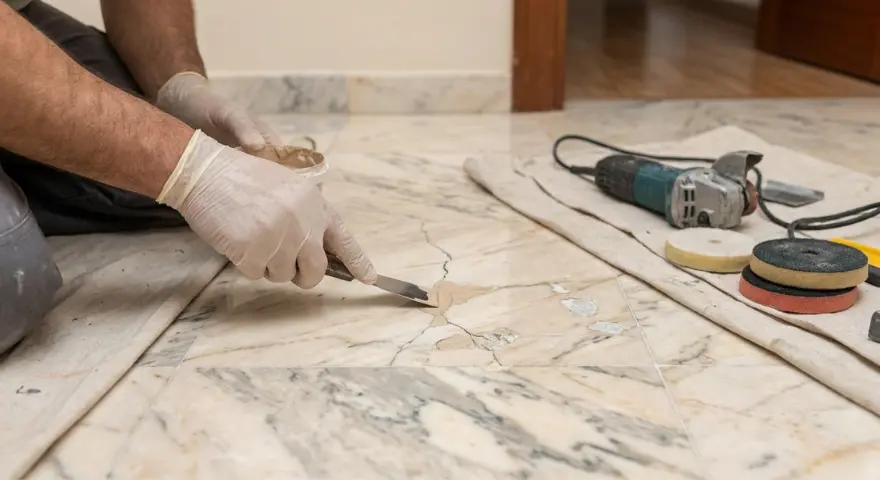
A cracked or chipped marble floor in a Dubai villa or penthouse is more than an aesthetic concern — it is a structural vulnerability that can spread, trap contaminants, and significantly diminish the value of your luxury property. Whether caused by a dropped object, furniture movement, thermal stress, or subfloor settlement, marble cracks in Dubai homes demand expert intervention, not guesswork. This guide covers everything you need to know about professional marble crack and chip repair services in Dubai — including why cracks happen, what the restoration process involves, and how to choose the right specialists for seamless, colour-matched results.
Why Does Marble Crack and Chip in Dubai Properties?
Dubai's unique environment and construction practices create a specific set of conditions that make marble more susceptible to cracking than in most other parts of the world. Understanding the root causes is the first step toward both effective repair and long-term prevention.
Thermal Expansion and Air Conditioning Shock
Marble is a natural stone with measurable thermal expansion properties. In Dubai, outdoor temperatures routinely exceed 45°C in summer while indoor environments are maintained at 20–23°C by powerful air conditioning systems. This extreme temperature differential — sometimes a swing of 25°C or more across a single doorway — causes marble tiles to repeatedly expand and contract. Over time, this thermal cycling creates internal stress fractures, particularly along grout joints and in areas where expansion gaps were not correctly installed during the original fit-out.
Subfloor Movement and Settlement
Dubai's property market moves at extraordinary speed. Many residential towers and villa communities are completed on accelerated timelines, sometimes before concrete subfloors have fully cured and stabilised. As the structure settles — a process that can continue for 2–5 years after construction — the rigid marble tiles above cannot flex with the movement, resulting in structural cracks that run diagonally across tiles or straight through grout lines. Properties in newer communities across Dubai Hills, Mohammed Bin Rashid City, and similar recently developed areas are particularly susceptible to this type of damage.
Impact Damage
Heavy object drops are the most common single-event cause of marble chipping and cracking in residential Dubai properties. Marble's hardness makes it resistant to scratching but relatively brittle under sudden point-load impact. Dropping a heavy pan, a glass bottle, or a piece of furniture hardware can shatter or chip the surface of even the thickest Italian marble slab. Corner chips at tile edges and hairline cracks radiating from the impact point are the typical result.
Inadequate Expansion Joints
Professional marble installation requires precisely placed expansion joints — gaps filled with flexible sealant that allow the floor assembly to breathe as temperatures change. In many Dubai properties built or refurbished quickly, these joints are either omitted entirely or filled with rigid grout. When the floor has no room to expand, the weakest points — individual tiles — fracture instead. This is one of the most common causes of widespread cracking in Dubai villas with large-format marble slabs exceeding 120×60 cm.
In our experience across 2,500+ Dubai projects since 2010, approximately 60% of marble cracking cases in residential properties trace back to inadequate expansion joints or premature subfloor loading during construction — not the quality of the marble itself. Italian Calacatta and Carrara are among the world's finest stones; the issue is almost always installation practice, not material failure.
Types of Marble Cracks: Diagnosing the Damage
Not all marble cracks are equal. Professional diagnosis is essential before any repair work begins, because the correct treatment varies significantly depending on the type, depth, and cause of the damage.
- Hairline surface cracks: Fine, shallow cracks confined to the polished surface layer only. These are purely cosmetic and can be filled and polished invisibly in most cases without any structural intervention.
- Through-body cracks: Cracks that penetrate the full depth of the tile. These require structural epoxy injection followed by surface filling and polishing. If the crack is still active (moving), the underlying cause must be resolved first.
- Corner and edge chips: Physical loss of material at tile corners or edges, typically from impact. These require colour-matched polyester or epoxy filler, shaped and polished to recreate the original profile.
- Multiple radial cracks: A spider-web pattern of cracks radiating from a central impact point. This indicates significant force was applied and often means the tile has been structurally compromised and may require replacement.
- Grout joint cracks: Cracking along grout lines rather than through tile body — often the first visible sign of subfloor movement or thermal expansion problems. Requires grout removal, flexible sealant installation, and monitoring before full surface restoration.
- Hollow-sounding tiles: Not a visible crack, but a critical structural warning. A tile that produces a hollow sound when tapped has debonded from the subfloor adhesive bed. These tiles are extremely prone to cracking under foot traffic and should be re-bonded immediately.
Never fill marble cracks with standard household caulk, tile grout, or white toothpaste — a popular internet suggestion that causes permanent damage. These materials do not bond chemically to marble, discolour rapidly in UAE conditions, and leave a residue that prevents professional repair products from adhering correctly. If your tile is cracked, cover the area with a soft cloth to prevent dirt ingress and call a specialist.
The Professional Marble Crack Repair Process in Dubai
Professional marble repair in Dubai is a precise, multi-stage technical process that combines structural engineering principles with artistic colour-matching skill. Here is how our technical team approaches a crack or chip repair in a Dubai villa or penthouse:
Structural Assessment & Root Cause Analysis
Before any repair material is applied, our technicians conduct a thorough assessment using a tap test across the surrounding tiles to identify hollow areas, a raking light inspection to map the full extent of cracking, and a moisture reading to detect any water ingress through the damaged area. Critically, we identify whether the crack is active (still moving) or stable — an active crack cannot be successfully repaired until the underlying cause is resolved.
Crack Cleaning & Preparation
The crack is cleaned using compressed air and specialist stone-safe solvents to remove all dust, dirt, grease, and contaminants from within the fracture. This step is critical — any contamination between the repair material and the marble stone will prevent proper adhesion and cause the repair to fail within weeks. The surrounding surface is protected with masking tape to ensure clean, controlled application.
Colour Matching & Filler Preparation
This is the most skilled phase of any marble repair. Our technicians use specialist polyester and epoxy resin systems that are tinted on-site using pigment pastes to match the precise background colour and vein pattern of your marble. For complex stones such as Calacatta Gold or Statuario with bold grey and gold veining, this process involves layering multiple coloured resins to recreate the natural pattern of the stone. An experienced technician will spend 20–40 minutes on colour matching alone for high-value luxury marble.
Resin Injection & Filling
For through-body cracks, a low-viscosity structural epoxy is injected under slight pressure to penetrate the full depth of the fracture, bonding the two sides of the crack together at a molecular level. A second application of colour-matched filler resin is then applied to the surface to fill the void flush with the surrounding marble. Slight overfilling is intentional — the excess is removed during grinding.
Diamond Grinding & Surface Levelling
Once the filler has fully cured, the repair area is carefully ground flush using fine diamond tooling. This removes the excess filler and levels the repaired surface precisely with the surrounding marble. Skill and patience are required at this stage to avoid over-grinding and creating a visible low spot or damaging the surrounding polished surface.
Progressive Polishing & Finish Matching
The repaired area is polished through a progressive sequence of diamond pads, matching the gloss level of the surrounding floor. A crystallization compound is applied at the final stage to ensure the repair area has the same reflectivity and hardness as the original polished surface. The goal — and what separates a professional repair from an amateur one — is that the repair should be invisible from standing height under all lighting conditions.
Repair vs. Replace: Making the Right Decision for Your Dubai Marble
One of the most common questions Dubai homeowners face after discovering cracked marble is whether to repair or replace the damaged tile. The answer depends on several factors, and a professional assessment is always recommended before a decision is made.
| Attribute | Professional Repair | Full Tile Replacement |
|---|---|---|
| Suitable damage type | Hairline cracks, chips, single through-body cracks | Shattered tiles, multiple radial cracks, debonded tiles |
| Result visibility | Invisible from standing height when professionally done | New tile may not match aged, patinated surrounding marble |
| Cost comparison | Significantly lower — fraction of replacement cost | Higher — includes tile sourcing, adhesive, grouting, disposal |
| Time required | Half to one day per repair area | 1–3 days including curing time |
| Structural integrity | Restored to near-original strength with epoxy injection | Full structural integrity restored with new tile |
| Risk of further damage | Low if underlying cause is resolved | Low, but new tile faces same conditions |
| Recommended for luxury Italian marble | Yes — preserves original stone and patina | Only when structurally unavoidable |
The Art of Colour Matching for Dubai's Luxury Marble
Dubai's most prestigious properties feature some of the world's most visually complex natural stones. Successfully repairing a crack in Calacatta Gold marble in a Palm Jumeirah villa is a fundamentally different challenge to repairing a crack in Crema Marfil in a Dubai Marina apartment, and it requires a different skill set.
White and cream marbles (Calacatta Gold, Carrara White, Afyon White) are the most challenging to colour-match because the repair must blend into a pale, bright background while also recreating any veining that runs across the crack. Our technicians use multi-layer tinting techniques — applying a base resin then drawing veins with a fine artist's tool — to recreate the stone's natural pattern across the repair area.
Dark marbles (Nero Marquina, Emperador Dark) present a different challenge: the repair must achieve a deep, uniform black without the chalky or brown undertones that cheaper fillers produce. Specialist black-tinted resin systems with UV stabilisers are required to prevent the repair from fading to grey in Dubai's strong indirect light conditions.
Veined marbles (Statuario, Arabescato, Saint Laurent) require the most artistic skill. The technician must study the direction, width, and colour graduation of the surrounding veins and recreate them through the repair area so that the eye follows the vein naturally across the tile without detecting any discontinuity.
This level of colour-matching expertise is precisely why professional marble restoration in Dubai from a qualified specialist delivers results that any general contractor or DIY kit simply cannot replicate.
Emergency Marble Repair: When to Call Immediately
Some marble damage situations in Dubai villas and apartments require urgent professional attention — not because the cosmetic issue cannot wait, but because delay allows the damage to worsen or creates safety and health risks.
- Sharp exposed edges: A chipped tile with exposed sharp edges is a safety hazard, particularly in households with children. Immediate temporary protection and prompt professional repair are required.
- Cracks near wet areas: Cracked marble in bathrooms, kitchens, or around pool areas allows water to penetrate beneath the tile, reaching the adhesive bed and subfloor. This can cause rapid delamination and mould growth. Emergency repair or temporary waterproof sealing should be arranged within 24–48 hours.
- Rapidly spreading cracks: If a crack has visibly grown in length or width over a short period, this indicates the underlying cause (subfloor movement or thermal expansion) is still active. The floor should be assessed immediately before further tiles are affected.
- Pre-sale or tenancy inspections: A cracked marble floor will be flagged in any property inspection report in Dubai and will reduce the assessed value of the property. Emergency repair before an inspection protects your investment and negotiating position.
- Holiday home pre-arrival: If you are returning to a Dubai property that has been vacant, a cracked tile may have worsened significantly during the absence due to thermal cycling in an unoccupied, uncontrolled environment. Professional assessment before guests or tenants arrive is strongly recommended.
If you discover a crack and cannot arrange professional repair immediately, apply a strip of clear packing tape across the crack. This prevents dirt and moisture from entering the fracture — which would make colour-matching significantly harder — and does not damage the marble surface when removed. Do not apply any liquid sealers, adhesives, or fillers yourself before the professional arrives.
Preventing Marble Cracks in Your Dubai Property
While professional repair delivers excellent results, preventing damage is always preferable — particularly for irreplaceable rare marble varieties that can no longer be sourced in matching batches. These preventative measures are especially important in Dubai's demanding climate.
Install Proper Expansion Joints
If your property was built or renovated without correct expansion joints — or with rigid grout filling where flexible sealant should be — this is the single most important preventative measure you can take. A qualified marble restoration specialist in Dubai can assess your floor layout, identify where expansion joints are missing, and install flexible sealant strips to relieve the thermal stress that causes cracking.
Use Furniture Pads and Floor Protectors
Every piece of furniture in contact with marble floors in a Dubai villa should have high-quality felt or silicone pads on all legs and base points. This applies to dining chairs, sofas, console tables, and especially moveable items like bar stools. The single most common cause of marble chips in domestic Dubai properties is a chair leg dragged without a pad, catching a tile edge at the wrong angle.
Maintain Consistent Indoor Temperature
Avoid extreme temperature swings in your property. Setting the AC to 18°C when you arrive home after a day out and then turning it off completely when you leave creates the worst possible thermal cycling conditions for marble. A consistent set-point of 23–25°C — even when the property is unoccupied — dramatically reduces the thermal stress on marble floors and grout joints. For properties left vacant during summer months, this is particularly important and should be factored into your property management instructions.
Annual Professional Inspection
Schedule an annual professional inspection of your marble floors as part of your property maintenance programme. A trained technician can identify micro-cracks, hollow tiles, and failing expansion joints before they develop into serious damage, allowing minor preventative work to be carried out at a fraction of the cost of emergency repair or tile replacement.