
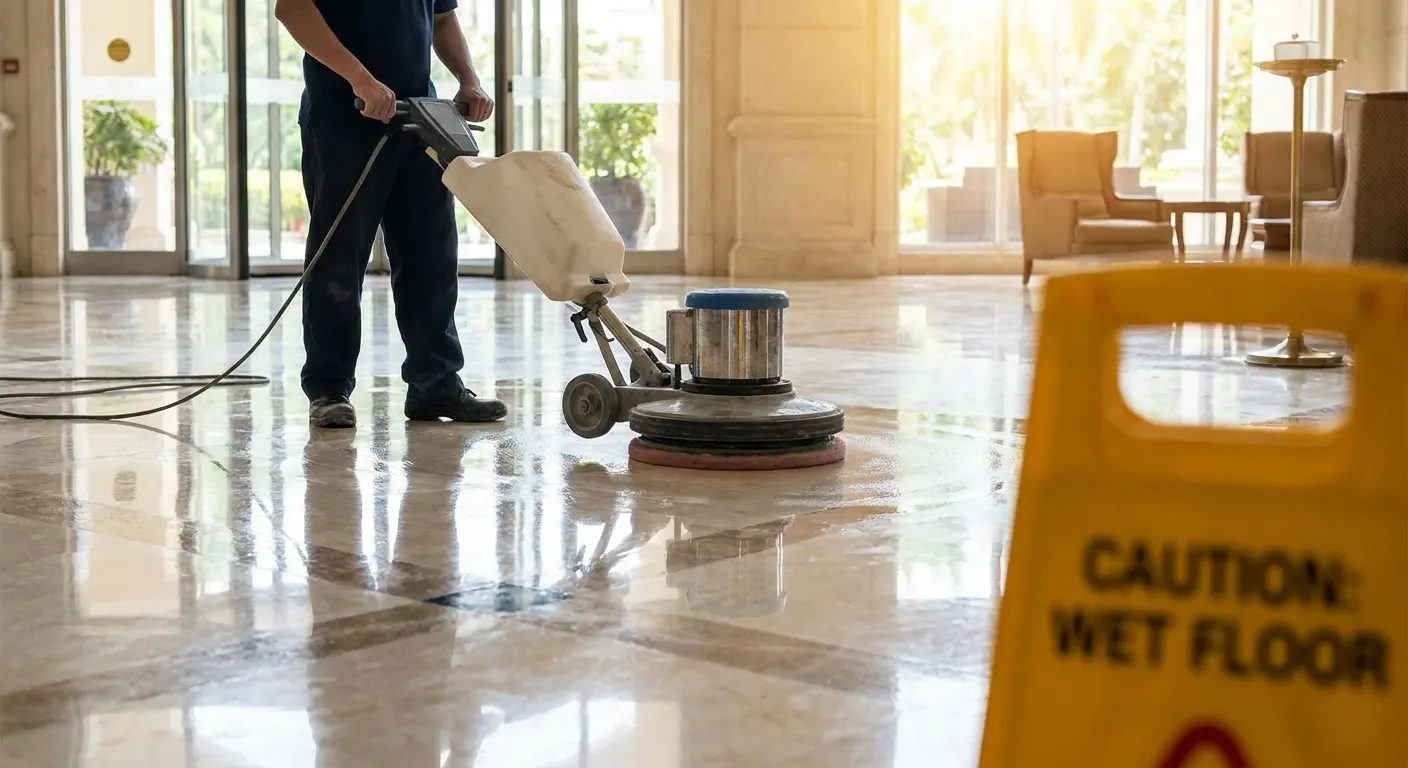
Dubai is one of the world's most architecturally ambitious cities — and its luxury properties are built to impress. Italian Carrara marble, Calacatta Gold, and Turkish Statuario line the floors of Palm Jumeirah villas and Downtown penthouses alike. Yet the same climate that makes Dubai's skyline shimmer is quietly working against your marble every single day. Here is the complete guide to understanding why marble polishing degrades faster in Dubai than anywhere else, and how professional diamond polishing is the only reliable solution.
Why Dubai's Climate Is Uniquely Harsh on Marble
Natural marble is calcium carbonate — a relatively soft, porous stone that reacts chemically with acids, physically with abrasives, and structurally with moisture fluctuations. Dubai's environment delivers all three stressors simultaneously and at extremes that most marble-producing regions of the world never experience.
Desert Silica: The Invisible Sandpaper
Dubai sits on the edge of the Rub' al Khali desert. Fine silica dust — particles often smaller than 10 microns — infiltrates even sealed buildings through gaps around doors, windows, and ventilation systems. When this dust settles on polished marble and is walked across, it functions exactly like an ultra-fine abrasive pad, microscopically scratching the surface with every footstep. Over weeks, a mirror finish becomes hazy; over months, it develops a noticeable matte quality that no household cleaner can reverse.
Air Conditioning and the Humidity Cycle
Dubai's interiors maintain a constant battle against outdoor humidity (which peaks above 90% during summer months). Air conditioning systems cycle cool, moisture-carrying air across flooring. When the AC cycles off or during coastal breeze events, warm humid air contacts the cooler marble surface and deposits micro-condensation into the stone's pores. This repeated wet-dry cycling causes calcium carbonate etching from within, gradually breaking down the crystalline surface layer that gives marble its reflectivity.
In temperate European climates, professionally polished marble typically holds its finish for 3–5 years. In Dubai, the same floor under the same foot traffic conditions will require professional re-polishing within 12–18 months. The UAE climate simply accelerates degradation by a factor of 2–3×.
Hard Water: The Stain Accelerator
Dubai's municipal water supply has a very high mineral content — Total Dissolved Solids (TDS) levels typically ranging from 300 to 600 ppm. When this water evaporates on marble surfaces (from mopping, splashing, or cleaning), it leaves behind calcium and magnesium deposits as white hazy residue. Over time these deposits bond into the stone surface, creating what are commonly called water marks or limescale stains. Importantly, the common instinct to use acidic cleaners (vinegar, lemon) to remove limescale causes catastrophic etching on marble and should never be done.
Signs Your Dubai Marble Needs Professional Polishing
Marble floors rarely fail dramatically — they degrade gradually. Watch for these early indicators that professional intervention is needed:
- Lost reflectivity: You can no longer see a sharp, clear reflection of ceiling lights or chandeliers in the floor surface.
- Visible traffic paths: Lighter or duller areas appear along walking routes, especially from entrance to living areas.
- Whitish haziness: A cloudy, milky appearance that doesn't disappear after cleaning — a sign of micro-scratching and limescale accumulation.
- Dull patches after cleaning: Instead of becoming shinier after mopping, the floor looks flatter — because the cleaning is removing polish rather than dirt.
- Etching marks: Dull spots with slightly rough texture, typically near kitchen counters or bathroom vanities where liquids have contacted the stone.
- Surface feels rough to the touch: Polished marble should feel glassy smooth. Texture indicates micro-abrasion has removed the top crystalline layer.
Never attempt to restore marble shine using off-the-shelf "marble polish" sprays or wax products sold in supermarkets. These products deposit a temporary coating that masks the problem while trapping contaminants beneath — making professional restoration more difficult and costly when the coating eventually degrades.
The Professional Diamond Polishing Process for Dubai Marble
Professional marble polishing in Dubai involves a precise multi-stage abrasive process using industrial diamond tooling — not polishes, sprays, or waxes. Here is how our team approaches a typical villa floor in Palm Jumeirah or Emirates Hills:
Assessment & Diagnosis
We begin with a thorough inspection under raking light to map scratch patterns, etch marks, lippage (tile height variation), and staining. This determines whether honing (grinding) or polishing alone is required, and which grit progression is appropriate for the stone type and damage level.
Coarse Diamond Honing (if required)
For heavily scratched or deeply etched surfaces, we begin with coarse diamond pads (50–100 grit) mounted on planetary grinding machines. This removes the damaged layer entirely, creating a uniformly flat surface to build the finish upon. Water is used throughout to suppress dust and cool the diamond tooling.
Progressive Abrasive Refinement
We work through a graded sequence of diamond pads — typically 200, 400, 800, 1500, and 3000 grit — each stage removing the scratch pattern left by the previous. This is the most time-consuming phase and cannot be rushed; skipping grits leaves visible scratch patterns in the final finish.
Crystallization or Nano-Sealing
At the final grit stage, a crystallization compound (typically containing magnesium fluorosilicate) is worked into the surface using steel wool pads under the machine. This reacts chemically with the calcium carbonate in the marble to create a harder, more reflective, and more stain-resistant vitrified layer — ideal for Dubai's environmental conditions.
Final Inspection & Protective Sealing
The completed surface is inspected under multiple light angles to confirm uniform reflectivity. A penetrating nano-sealer is then applied, which fills the stone's micro-pores to resist Dubai's hard water staining and humidity-driven moisture penetration without altering the stone's appearance.
Polishing vs. Honing: Which Does Your Floor Need?
These two terms are frequently confused. Understanding the difference helps you communicate clearly with any stone care provider and avoid paying for work your floor does not need — or worse, not getting the work it does.
| Attribute | Polishing | Honing (Grinding) |
|---|---|---|
| What it addresses | Light surface haziness, minor scratches, dullness | Deep scratches, heavy etching, lippage, extensive damage |
| Material removal | Minimal — surface refinement only | Significant — removes damaged layer entirely |
| Resulting finish | High-gloss mirror shine | Matte or satin; then polished to gloss in further stages |
| Typical Dubai frequency | Every 12–18 months | Every 5–8 years (or after damage events) |
| Time required | Shorter — 1 day for typical villa | Longer — 2–4 days depending on damage level |
| Suitable for light wear | Yes | No |
| Required for structural damage | No | Yes |
Maintaining Your Marble Between Professional Visits
Professional polishing is the foundation, but daily habits determine how long the results last in Dubai's environment. Following these practices consistently can extend the interval between professional treatments by 30–50%.
Daily Cleaning Protocol
Use only a pH-neutral stone cleaner (pH 7 — look for products explicitly labelled "safe for natural stone"). Dilute in distilled or filtered water, not Dubai tap water, to avoid introducing mineral deposits. Mop with a clean microfibre pad using minimal moisture, and always follow immediately with a dry microfibre buff. Never allow water to sit on marble.
Strategic Dust Management
Given Dubai's silica dust levels, dry dust mopping twice daily in high-traffic areas is recommended. Use a specialist marble dust mop with electrostatic microfibre that captures particles rather than redistributing them. Place high-quality, large-format entrance mats at every door — these need to be at least 1.5 metres deep to allow two full steps on the mat before marble contact.
Humidity & Temperature Management
Maintain consistent indoor temperature and humidity levels. Avoid running AC on maximum then turning it off completely — the thermal shock and humidity swings this creates accelerate the micro-condensation cycle described earlier. A consistent 23–25°C with 50–55% relative humidity is ideal for marble longevity.
Apply a high-quality topical marble guard spray (we recommend impregnating sealers, not surface coatings) every 6 months in Dubai. This top-up sealing between professional treatments acts as a sacrificial barrier, absorbing some of the environmental damage before it reaches the stone's polished crystalline layer.
Which Marble Types Are Most Common in Dubai Properties?
Different marble types behave differently under Dubai conditions. Knowing your stone helps you have more informed conversations with any restoration professional.
Calacatta Gold & Carrara White (Italian marbles) are the most prestigious and the most sensitive. Their bright white backgrounds show staining, etching, and yellowing more visibly than darker stones. They require the most attentive maintenance programme in Dubai and benefit most from regular crystallization sealing.
Statuario & Arabescato similarly require careful handling. The bold grey veining that makes these stones visually spectacular also creates structural variation in hardness that requires careful diamond pad pressure management during polishing.
Emperador Dark & Nero Marquina (Spanish marbles) are more forgiving in terms of stain visibility but require specialist dark-stone sealers to prevent white calcium from hazing the surface during crystallization treatments.
Turkish Afyon White & Crema Marfil are frequently used in Dubai bathroom and kitchen applications. Their relatively warmer beige tones hide limescale somewhat better but are equally susceptible to acid etching from cleaning products.
How to Choose a Marble Polishing Company in Dubai
Dubai has many operators advertising marble services. Separating professional stone care companies from general cleaning contractors claiming marble expertise is critical, as poor-quality work can permanently damage your flooring investment.
- Verify equipment: Professional companies use industrial planetary grinding machines (brands like Klindex, HTC, or Husqvarna). A company using single-disc floor polishers cannot achieve professional results on marble.
- Ask about diamond grit progression: A professional should be able to describe the specific grit sequence they will use for your floor condition. Vague answers indicate lack of expertise.
- Request before/after references: Ask for photos and contact details of comparable Dubai properties — villas and apartments similar to yours in terms of marble type and square footage.
- Confirm wet polishing method: Dry polishing generates harmful silica dust and produces inferior results. All professional marble work should use continuous water feed.
- Check insurance: Marble polishing on luxury properties requires public liability insurance to cover accidental damage to high-value fittings and furnishings.