
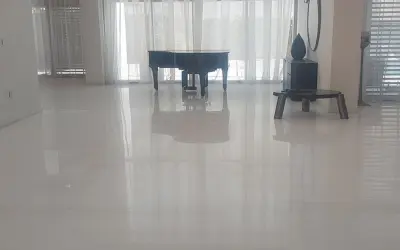
Dubai's luxury interiors are defined by their marble floors — Italian Calacatta, Carrara White, and Statuario line the living spaces of Palm Jumeirah villas, Downtown penthouses, and Emirates Hills estates alike. Yet every one of these premium surfaces faces a relentless adversary: Dubai's desert environment. If you have ever wondered why your professionally polished floor loses its brilliance faster than expected, the answer lies in a treatment most homeowners overlook. Marble crystallization is not simply an upgrade — in Dubai's climate, it is an essential layer of protection that standard polishing alone cannot provide.
What Is Marble Crystallization and How Does It Work?
Marble crystallization is a chemical surface-hardening process that goes fundamentally beyond conventional diamond polishing. While polishing uses progressively finer abrasive pads to mechanically refine the stone surface to a high-gloss finish, crystallization introduces a reactive chemical compound — most commonly magnesium fluorosilicate — that is worked into the marble under machine friction and heat.
The chemical reacts directly with the calcium carbonate in the marble's crystal structure, forming a new compound at the surface layer: calcium fluorosilicate. This reaction produces a denser, harder, and more reflective crystalline matrix than the original stone surface. The result is what professionals refer to as a vitrified layer — a glassy, fused surface that is chemically bonded to the stone rather than simply sitting on top of it like a coating or wax.
Unlike topical sealers or surface coatings, crystallization does not add a film that can peel, cloud, or trap contaminants beneath it. The process chemically modifies the marble itself at a microscopic depth of 0.5–1.5mm, creating permanent improvement in hardness, gloss, and slip resistance that forms an integral part of the stone.
Crystallization vs. Standard Polishing: The Key Difference
Standard diamond polishing achieves a mirror finish by removing the damaged surface layer and refining the stone to a high grit count — typically 1500 to 3000 grit. The result is visually impressive but leaves the underlying calcium carbonate surface exposed to the same environmental stressors that caused deterioration in the first place. Crystallization seals that equation. By forming a harder outer layer, it dramatically slows the rate at which desert silica, cleaning chemicals, and humidity cycling can degrade the surface between professional maintenance visits.
Why Dubai's Environment Makes Crystallization Essential
The case for crystallization is compelling in any climate, but it becomes close to mandatory in Dubai. Three specific environmental factors converge in the UAE to attack marble floors at an accelerated rate that homeowners in Europe or North America simply do not encounter.
The Desert Silica Problem
Dubai sits on the fringe of the Arabian Peninsula's vast desert interior. Ultra-fine silica particles — often under 10 microns in diameter — penetrate even well-sealed buildings through door gaps, ventilation systems, and air conditioning intakes. Once indoors, these particles settle invisibly on marble surfaces. When walked across, they function as a continuous abrasive, microscopically scratching the surface with every footstep. On a standard polished floor, this silica abrasion progressively dulls the finish from the very first day after treatment. On a crystallized surface, the harder vitrified layer absorbs and resists this micro-scratching far more effectively, preserving the mirror-shine significantly longer.
AC-Driven Humidity Cycling
Dubai's air conditioning infrastructure is among the most intensive in the world, running continuously for the majority of the year. This constant cycling creates a specific hazard for marble: as cool, moisture-laden air contacts the comparatively cooler marble surface, micro-condensation forms within the stone's pores. During periods when the AC is reduced or coastal breezes introduce warm, humid air, evaporation occurs. This repeated wet-dry cycling gradually etches calcium carbonate from the stone's interior, weakening the crystalline bonds that determine surface hardness and reflectivity. The vitrified layer created by crystallization is significantly more resistant to this moisture-driven etching than untreated marble.
Hard Water and Limescale Accumulation
Dubai's municipal water supply carries very high mineral content, with Total Dissolved Solids (TDS) measurements regularly exceeding 400 ppm. Routine mopping, splashing, and cleaning with this water leaves calcium and magnesium deposits on marble surfaces as the water evaporates. Over time, these deposits bond into the stone's pores, creating the hazy white residue known as limescale. On an untreated polished surface, limescale penetrates readily. On a crystallized floor, the denser surface structure and reduced porosity significantly impede limescale bonding, making routine cleaning far more effective and reducing the depth of professional intervention required during subsequent maintenance visits.
Never attempt to remove limescale from marble using acidic cleaners such as vinegar, lemon juice, or descaling sprays. These products cause irreversible chemical etching on calcium carbonate stone. The correct approach is a specialist pH-neutral stone cleaner and professional intervention where deep staining has occurred.
The Measurable Benefits of Marble Crystallization in Dubai
Homeowners who invest in professional marble crystallization in Dubai typically observe a clear set of improvements that justify the treatment as a long-term investment rather than a discretionary expense.
- Superior gloss retention: The vitrified surface maintains its mirror-shine significantly longer than standard polishing, resisting the dulling effect of daily silica abrasion in Dubai's desert environment.
- Improved slip resistance: Crystallization measurably increases the surface friction coefficient of marble floors, reducing slip risk — particularly important in bathroom and kitchen areas where wet surfaces are common.
- Enhanced stain resistance: The denser, less porous crystallized surface resists penetration by spilled liquids, food oils, and Dubai's hard water mineral deposits more effectively than untreated stone.
- Longer intervals between professional treatments: A properly crystallized floor in a Dubai residential property typically requires professional re-treatment every 18–24 months, compared to 12–18 months for standard polishing alone.
- Reduced maintenance effort: Day-to-day cleaning becomes easier and more effective because contaminants cannot penetrate the vitrified layer as readily, meaning less time and product required to maintain the floor's appearance.
- Surface hardness increase: The Mohs hardness of the crystallized surface layer is measurably higher than untreated marble, improving resistance to scratching from furniture, footwear, and everyday traffic.
The Professional Crystallization Process: Step by Step
Understanding what professional marble polishing and crystallization in Dubai actually involves helps homeowners evaluate service providers and set realistic expectations for the treatment outcome.
Surface Preparation and Cleaning
The floor is deep-cleaned using a specialist alkaline stone cleaner to remove all existing wax, coating residue, limescale, and embedded soil from the pores. This step is non-negotiable: crystallization chemicals cannot bond properly through contaminants, so surface preparation directly determines the quality and durability of the finished result.
Diamond Honing and Polishing
The floor is worked through a progressive sequence of diamond abrasive pads — from coarse (100–400 grit) to fine (800–3000 grit) — depending on the current condition of the surface. This stage removes existing scratch patterns, etch marks, and surface irregularities, creating a uniformly refined base on which the crystallization compound will react most effectively.
Crystallization Compound Application
The magnesium fluorosilicate crystallization compound is applied to the prepared surface in controlled sections. A floor machine fitted with a natural steel wool pad is then worked across the compound under moderate pressure. The combination of machine friction, heat generated by the steel wool, and the chemical's reaction with calcium carbonate triggers the surface crystallization reaction.
Buffing and Gloss Development
Once the chemical reaction is complete, the surface is buffed with a clean dry pad to remove any residual compound and develop the full gloss of the newly vitrified layer. The result at this stage is typically a high-reflectivity, glassy surface with noticeably improved depth of shine compared to diamond polishing alone.
Inspection and Optional Nano-Sealing
The completed surface is inspected under raking light at multiple angles to confirm uniform vitrification and gloss consistency. In Dubai's environment, we recommend applying a penetrating nano-sealer as a final step, which fills the stone's remaining micro-pores to further resist hard water mineral penetration between maintenance visits.
Crystallization vs. Nano-Sealing: Understanding Both Treatments
These two treatments are complementary, not interchangeable. Many Dubai homeowners encounter both terms and assume they describe the same service — understanding the distinction ensures you get the protection your floor actually requires.
| Attribute | Crystallization | Nano-Sealing |
|---|---|---|
| How it works | Chemical reaction with calcium carbonate in the stone | Nano-particles fill micro-pores without chemical reaction |
| What it modifies | The stone surface itself — permanent structural change | The pore structure — fills gaps without altering the stone |
| Gloss improvement | Significant — improves reflectivity beyond polishing | Minimal — preserves existing gloss |
| Hardness improvement | Yes — measurably increases Mohs hardness | No — does not affect surface hardness |
| Stain resistance | Good — denser surface resists penetration | Excellent — fills pores directly to block liquid ingress |
| Slip resistance | Yes — improves friction coefficient | Neutral — does not significantly affect slip resistance |
| Recommended use | Primary treatment after polishing for Dubai floors | Supplementary top-up between professional treatments |
Which Marble Types Benefit Most from Crystallization in Dubai?
Crystallization is effective on all calcium carbonate-based natural stones, which encompasses the vast majority of marble types used in Dubai's luxury residential and commercial properties. However, the treatment characteristics and required product selection vary by stone type.
Calacatta Gold and Carrara White — the prestige white Italian marbles found throughout Palm Jumeirah and Downtown Dubai properties — respond exceptionally well to crystallization. Their bright white backgrounds display the gloss improvement most visibly, and the vitrified layer helps prevent the yellowing and grey-toning that Dubai's humidity can introduce into lighter stone over time.
Statuario and Arabescato are similarly well-suited. These stones' structural variation between their white matrix and grey veining requires careful compound application to achieve uniform crystallization, but the results on high-quality specimens are outstanding — particularly in the depth and brilliance of the finished gloss.
Crema Marfil and Turkish Afyon White are among the most commonly crystallized stones in Dubai. Their warm beige tones are frequently used in bathroom flooring, where the slip resistance benefit of crystallization provides a practical safety advantage alongside the aesthetic improvement.
Emperador Dark and Nero Marquina require specialist dark-stone crystallization compounds to prevent the formation of white calcium hazing on the surface — a result of using standard compounds on low-calcium dark stones. When treated correctly by experienced technicians, these stones achieve a depth of gloss that is particularly striking against their deep brown and black base tones.
In Dubai villas where Calacatta or Carrara marble covers large open living areas, we recommend crystallization at every professional maintenance visit rather than alternating with standard polishing. The UAE's dust load is high enough that the additional surface hardness provided by crystallization makes a measurable difference in how long the floor retains its quality appearance between visits.
Maintaining a Crystallized Marble Floor in Dubai
Crystallization extends the life of your floor's professional finish, but it does not eliminate the need for correct daily maintenance. Following these practices consistently after treatment will maximise your investment and extend the interval before the next professional visit.
Daily Cleaning
Use only a pH-neutral stone cleaner — look for products explicitly labelled safe for natural stone and crystallized marble. Dilute according to the manufacturer's instructions using distilled or filtered water rather than Dubai tap water, which will leave mineral deposits. Apply with a clean microfibre mop using minimal moisture and always follow immediately with a dry microfibre buff. Never allow standing water on a crystallized marble floor.
Dust Control in Dubai Conditions
Given Dubai's desert silica levels, dry dust mopping should be performed twice daily in high-traffic zones. Use electrostatic microfibre pads that trap particles rather than redistributing them. At all exterior entry points, install large-format entrance matting of at least 1.5 metres depth — this is the single most effective measure for reducing the volume of abrasive silica reaching your crystallized surface. Also refer to our guide on best marble cleaning practices for Dubai's hard water for a complete daily care protocol.
What to Avoid
Never use acidic cleaners, bleach, ammonia-based products, or any multi-surface household cleaner on crystallized marble. Avoid dragging furniture across the surface and fit felt pads to all chair and table legs. Do not use steam mops — the high-temperature moisture penetrates the vitrified layer and can introduce the same humidity-driven micro- etching that crystallization is designed to resist. Do not apply waxes or surface coatings over a crystallized floor, as these trap contaminants and interfere with future crystallization treatments.
Choosing a Marble Crystallization Specialist in Dubai
Crystallization is a skilled process that produces significantly different results depending on the knowledge, equipment, and compounds used. In Dubai's contractor market, not all companies offering crystallization are performing the genuine chemical process — some use superficially similar products that provide only temporary surface hardening without true vitrification.
- Ask about the compound used: Professional crystallization uses magnesium fluorosilicate-based compounds from established European stone care brands. A vague answer or unwillingness to name the product is a warning sign.
- Verify machine type: True crystallization requires a floor machine capable of maintaining the correct speed and pressure to generate the friction heat that drives the chemical reaction. Hand application without machine work does not produce genuine crystallization.
- Confirm pre-treatment procedure: A professional will always include full surface preparation and diamond polishing before applying crystallization compound. Skipping pre-treatment steps produces inferior bonding and dramatically reduces durability.
- Request property references: Ask for before-and- after photographs and contact details for comparable Dubai properties — ideally in similar communities and with the same marble type as yours.
- Check insurance coverage: Any company working on luxury marble floors in Dubai should carry public liability insurance sufficient to cover accidental damage to high-value property fittings and furnishings.